
Vapi Alternatives in 2026: 6 Voice AI Platforms Compared
Vapi is a great toolkit — but a toolkit and an operation are different purchases. Six alternatives compared, the build-vs-buy iceberg, and where each path wins.


Last reviewed: July 2026
TL;DR
Vapi is a strong developer toolkit; alternatives depend on what you're optimizing for. Retell AI is the closest API substitute, Bland fits outbound, Synthflow is no-code, LiveKit is open-source control — and operating platforms like Anyreach fit teams that need omnichannel follow-through, multi-client tenancy and compliance tooling without building it. Compare architectures with the same 4–6 week live pilot: containment, engineering hours, day-one reporting.
Vapi Is a Great Toolkit — That's Exactly the Question
Vapi earned its reputation honestly: it is one of the fastest ways for a developer to get a working voice agent on a phone number, with deep control over models, voices and tool-calling. But a toolkit and an operation are different purchases. Teams typically start looking at Vapi alternatives when the surrounding software they have to build — analytics, QA, multi-tenant management, compliance workflows, non-voice channels — starts costing more than the API itself.
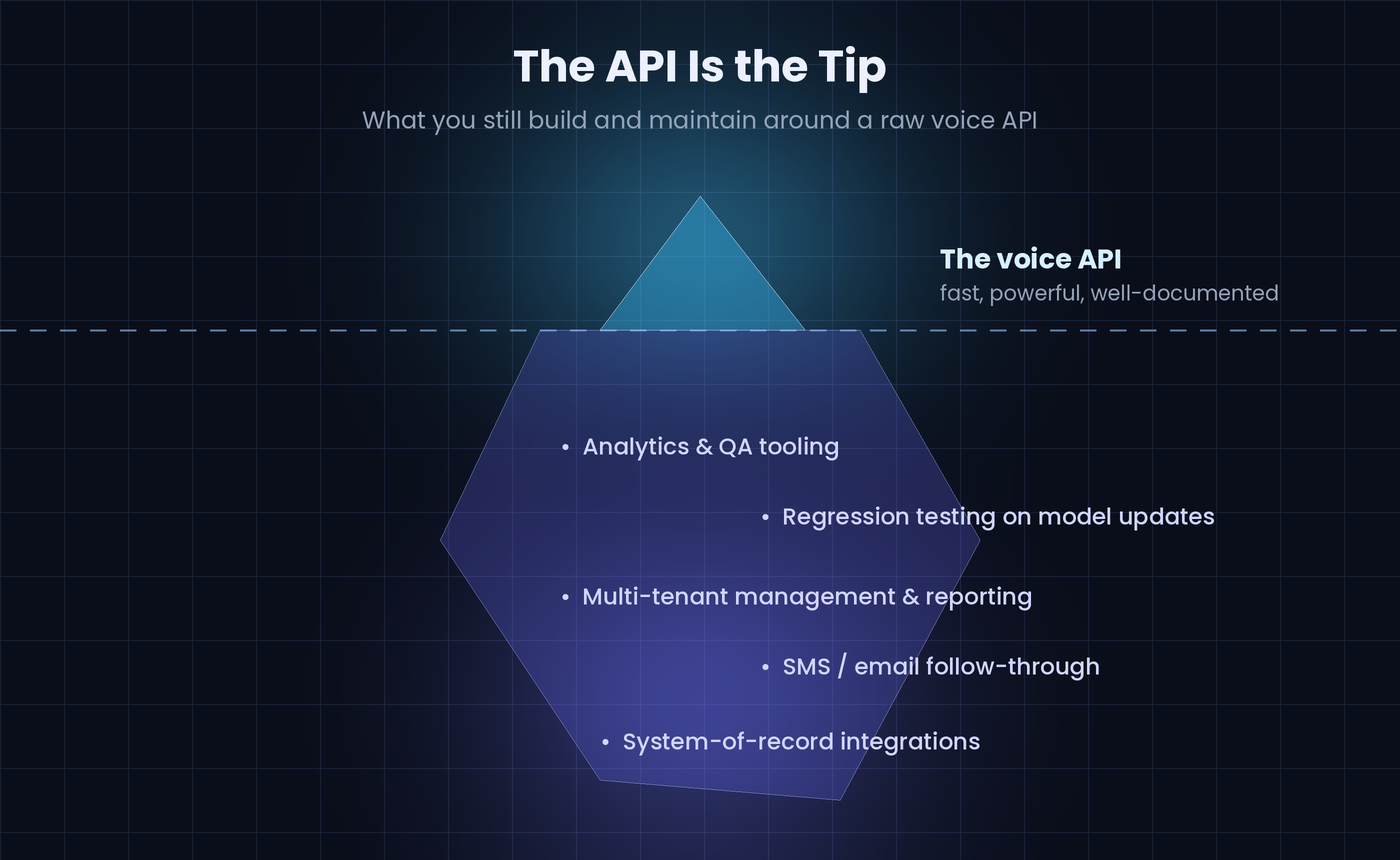
Below the waterline of any voice API sits the rest of the iceberg: prompt and flow management across versions, regression testing when models update, per-client reporting, escalation tooling, SMS and email follow-through, and the integration layer into the system of record. With a developer platform, all of that is yours to build and maintain. That's not a criticism — it's the product's design philosophy. The question is whether it matches your team.
The Alternatives, By What You're Optimizing For
| Alternative | Choose it when | Channels | Model |
|---|---|---|---|
| Anyreach | You want the whole operation — voice, chat, SMS, email orchestrated on top of your system of record, with multi-client architecture for agencies and BPOs | Voice, chat, SMS, email | Managed platform + partner program |
| Retell AI | You want a comparable developer API with strong docs and community | Voice | Self-serve API |
| Bland AI | Outbound calling volume is the core job | Voice | API + managed tiers |
| Synthflow | You want no-code agent building without engineering | Voice | No-code SaaS |
| LiveKit Agents | You're building fully custom real-time infrastructure and want open-source control | Voice, video | Open-source framework |
| PolyAI | Enterprise inbound IVR replacement with a services-led rollout | Voice | Enterprise managed |
The Build-vs-Buy Math Nobody Puts on the Pricing Page
Rate cards make developer APIs look dramatically cheaper. Total cost tells a different story. A production voice AI operation built on a raw API typically consumes ongoing engineering for flow changes and regression testing, analytics and QA tooling someone has to assemble, and integration maintenance every time the CRM, helpdesk, or telephony layer changes. For a single stable use case with a strong engineering team, that overhead is manageable and the control is worth it. For a portfolio of use cases or clients, the overhead multiplies per deployment — which is why agencies and BPOs, in particular, migrate toward platforms with tenancy, reporting and channel follow-through built in.
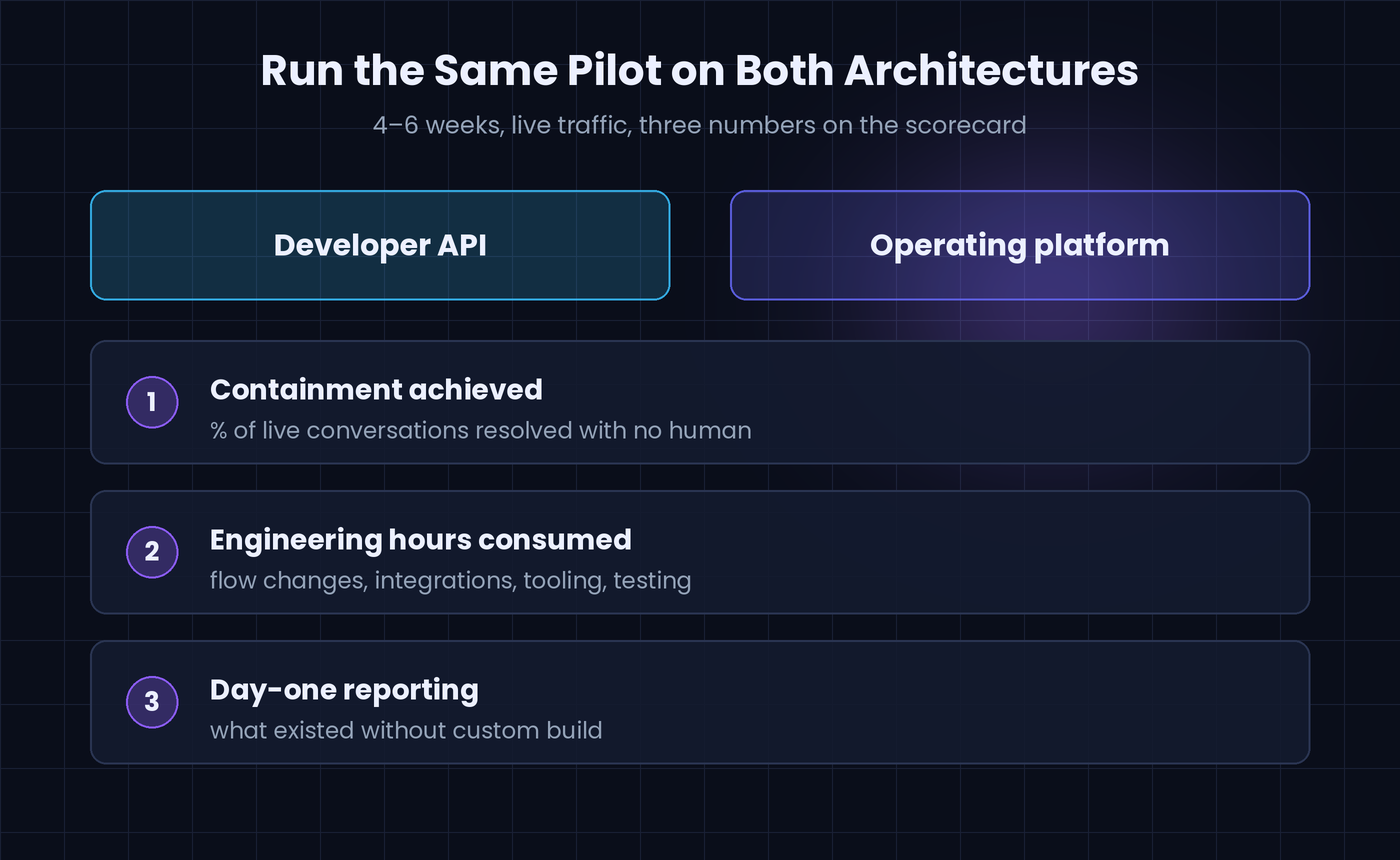
The honest way to compare: run the same scoped pilot on both architectures — one developer API, one operating platform — for 4–6 weeks on live traffic, and count three things: containment achieved, engineering hours consumed, and what reporting existed on day one. We laid out this evaluation pattern in our Retell AI alternatives guide, and it applies unchanged here.
Where Each Path Wins
Stay on Vapi (or move to Retell) when…
Voice is genuinely your only channel, you have engineering capacity you want spent on differentiation, and your use case is stable enough that flow changes are rare. Developer APIs reward teams that treat the voice agent as core product.
Move to an operating platform when…
The conversation doesn't end at the hang-up — follow-ups, case writes and cross-channel loops matter; you run multiple clients or brands; compliance requires audit trails and reporting you'd rather not build; or your success metric is a containment number a vendor should be contractually attached to. This is the architecture we describe in our BPO platform comparison — an interaction layer over the system of record rather than a voice endpoint beside it.
If the operating-platform path fits, book a walkthrough — we'll show a live multi-channel deployment, not a demo environment.
Frequently Asked Questions
What is the best Vapi alternative in 2026?
For a like-for-like developer API, Retell AI is the closest substitute. For outbound volume, Bland AI; for no-code building, Synthflow; for open-source control, LiveKit Agents. Teams that need omnichannel follow-through, multi-client operations, or compliance tooling out of the box typically move to an operating platform like Anyreach.
Is Vapi good for production customer support?
Vapi is production-capable as an API, but a support operation also needs analytics, QA, regression testing, reporting and escalation tooling built around it. Whether that build is worthwhile depends on engineering capacity and how many deployments you'll run.
Vapi vs Retell AI — what's the difference?
They compete closely as developer-first voice APIs; differences show up in pricing structure, model/voice flexibility, and ecosystem tooling rather than fundamentals. If you're choosing between them, the architecture question — API vs operating platform — usually matters more than the API you pick.
Can I migrate from Vapi without rebuilding everything?
Mostly yes: intents, flows and integration logic transfer conceptually even when implementation differs. Operating platforms typically rebuild flows in their orchestration layer during onboarding, using your existing call recordings and transcripts as the specification.
See how Anyreach handles your call volume
Book a live demo with a real deployment, not a slide deck.
Talk to Us![[BPO Insights] Where We're Going: The Anyreach Vision for the Next 18 Months](https://storage.ghost.io/c/40/ac/40ac18d7-d0cb-4132-9e8b-e6740dedd4ad/content/images/size/w600/2026/02/05_the_2028_thesis-17.png)
![[BPO Insights] Mid-Year Performance Benchmarks in AI-Powered BPO Deployments](https://storage.ghost.io/c/40/ac/40ac18d7-d0cb-4132-9e8b-e6740dedd4ad/content/images/size/w600/2026/02/04_the_builders_log-17.png)
![[BPO Insights] Year 2 Revenue Scaling Patterns in the Small-to-Enterprise BPO Market](https://storage.ghost.io/c/40/ac/40ac18d7-d0cb-4132-9e8b-e6740dedd4ad/content/images/size/w600/2026/02/03_the_uncomfortable_math-17.png)
![[BPO Insights] The Warmest Introduction I've Ever Gotten Came From Our Smallest Customer](https://storage.ghost.io/c/40/ac/40ac18d7-d0cb-4132-9e8b-e6740dedd4ad/content/images/size/w600/2026/02/02_from_the_other_side-17.png)