
Retell AI Alternatives in 2026: 6 Voice AI Platforms Compared
Why teams look beyond Retell AI, six alternatives mapped to switching reasons, and the API vs. operating-platform decision that matters more than latency benchmarks.


Last reviewed: July 2026
TL;DR
Teams outgrow Retell AI for four reasons: voice-only scope, build-vs-buy fatigue, multi-client operations, and enterprise requirements. Vapi is the closest developer-API substitute, Bland fits outbound volume, and full-stack platforms like Anyreach fit teams that need omnichannel orchestration deployed on top of an existing system of record. Evaluate two architectures — API vs. operating platform — with the same 4–6 week pilot on real traffic.
Why Teams Look Beyond Retell AI
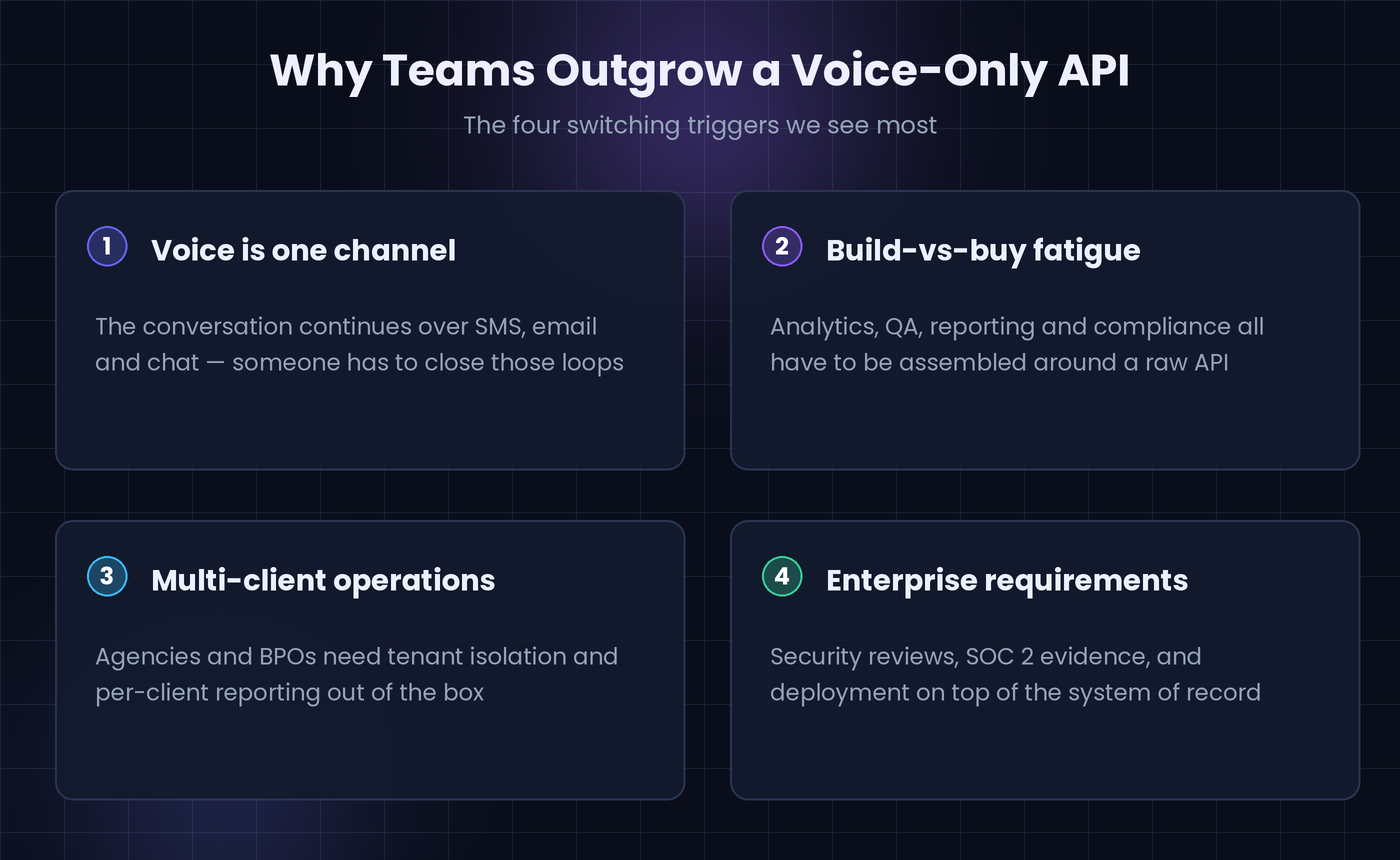
Retell AI earned its place as one of the most popular developer platforms for building voice agents — a clean API, fast time-to-first-call, and a large builder community. But "great API" and "right platform for our operation" are different questions, and teams typically start evaluating alternatives for one of four reasons:
1. Voice is only one channel. The conversation that starts on a call continues over SMS, email, and chat. Voice-only platforms leave that follow-through to be built and maintained in-house.
2. Build-vs-buy fatigue. An API is a starting point: analytics, QA tooling, client reporting, compliance workflows, and integrations still have to be assembled around it. Some teams want that control; many discover they are running a software project instead of a CX operation.
3. Multi-client operations. Agencies and BPOs need tenant isolation, per-client reporting, and repeatable deployment playbooks — capabilities developer APIs leave as an exercise for the buyer.
4. Enterprise requirements. Security reviews, SOC 2 evidence, deployment on top of an existing system of record, and a vendor who shows up to the client QBR.
The Alternatives, Mapped to Why You're Switching
| Alternative | Strongest when you need | Channels | Operating model |
|---|---|---|---|
| Anyreach | Full-stack omnichannel CX — voice, chat, SMS and email orchestrated together, deployed on top of your existing system of record; multi-client architecture for BPOs and agencies | Voice, chat, SMS, email | Managed platform + partner program |
| Vapi | Maximum developer control and rapid voice prototyping | Voice | Self-serve API |
| Bland AI | High-volume outbound calling programs | Voice | API + managed tiers |
| Synthflow | No-code voice agent building for smaller teams | Voice | Self-serve, no-code |
| PolyAI | Enterprise-scale inbound IVR replacement with a services-heavy rollout | Voice | Enterprise managed |
| Parloa | Standardizing large contact-center voice automation, especially in Europe | Voice, some chat | Enterprise managed |
The Real Decision: API vs. Operating Platform
Most "Retell alternatives" comparisons obsess over voice latency and model quality. In production, those differences narrow fast — every serious platform in 2026 produces natural-sounding, low-latency conversations. The durable difference is operational:
Who owns the outcome?
With an API, your team owns containment, escalation logic, QA, and reporting. With an operating platform, the vendor co-owns a number — typically a containment or resolution target written into the agreement. If your success metric is a percentage (say, 60%+ containment on a defined intent set within a quarter), you want a vendor contractually attached to that percentage.
What happens after the call?
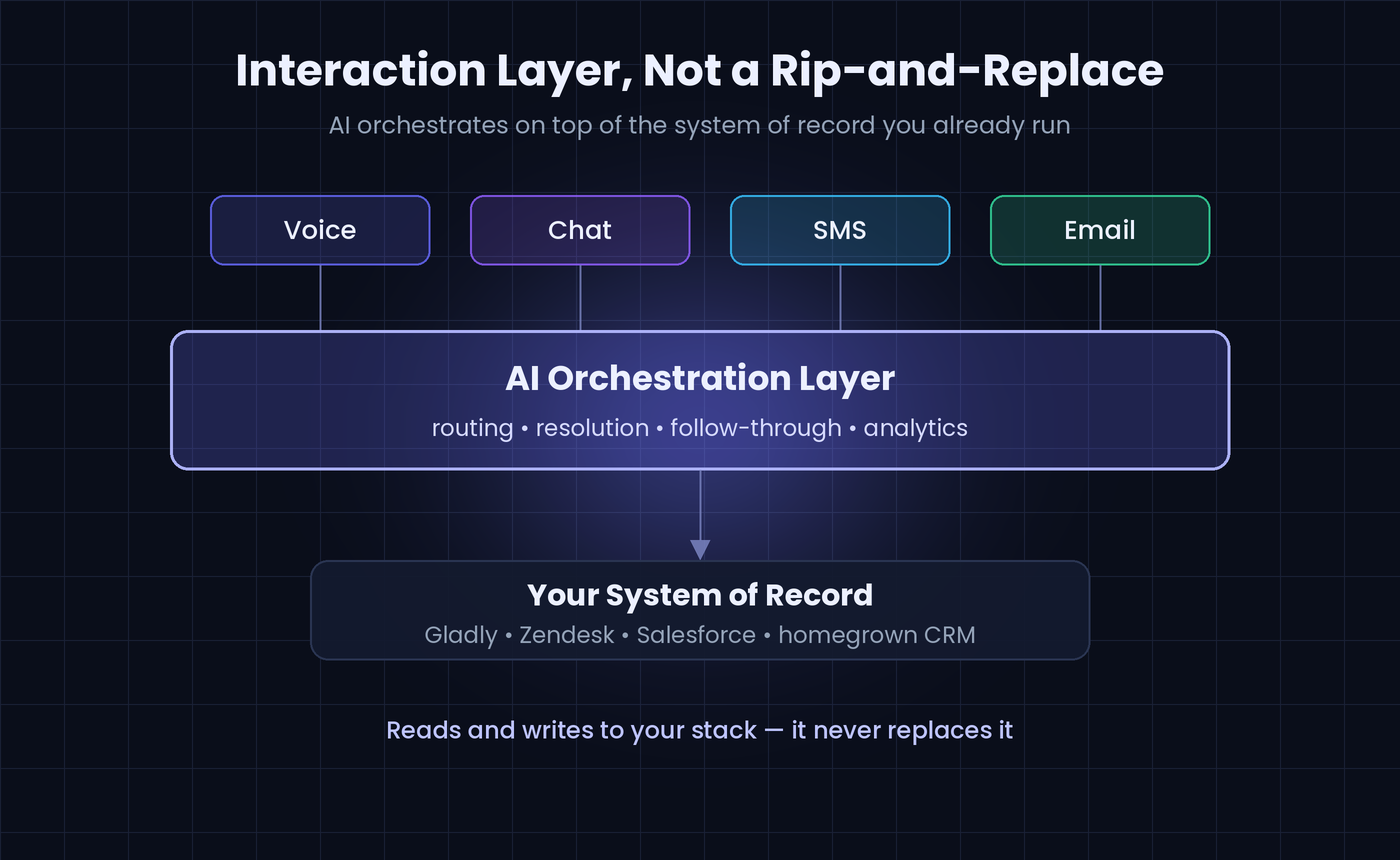
Resolution increasingly happens across channels: the voice agent confirms the issue, the follow-up lands by SMS, the case is written to the system of record, and an email closes the loop. Platforms designed as an interaction layer over your existing stack — rather than a voice endpoint beside it — close these loops without human glue work. This is the architectural difference between omnichannel orchestration and a voice API.
Can you repeat it twenty times?
For agencies and BPOs, the platform question is really a portfolio question: can you clone a proven deployment for the next client in weeks, with isolated analytics and client-facing reporting out of the box? That capability, more than any single feature, determines whether AI becomes a margin engine across your book of business.
How to Run a Fair Evaluation
Shortlist two architectures, not six logos: one developer API (keep Retell or Vapi in the mix) and one operating platform. Run the same scoped pilot on both — one intent set, real traffic, 4–6 weeks — and compare three things: containment on live conversations, engineering hours consumed, and what reporting existed on day one without custom work. The total-cost picture usually looks very different from the per-minute rate card.
If the operating-platform architecture fits your situation, book a walkthrough with our team — we'll show a live deployment on a stack like yours, not a demo environment.
Frequently Asked Questions
What is the best Retell AI alternative in 2026?
It depends on why you're switching. For maximum developer control, Vapi is the closest substitute. For outbound volume, Bland AI. For teams that need omnichannel orchestration, multi-client operations, or deployment on top of an existing system of record, a full-stack platform like Anyreach is the stronger fit.
Is Retell AI good for BPOs?
Retell AI is a capable developer API, but BPO operations typically need tenant isolation, per-client reporting, and repeatable deployment playbooks around it — which must be built in-house. Platforms with native multi-client architecture reduce that build burden significantly.
Can I use an AI voice agent without replacing my CRM or helpdesk?
Yes. Orchestration platforms deploy as an interaction layer on top of systems like Gladly, Zendesk or Salesforce, reading and writing to them rather than replacing them. This is usually the deciding requirement in enterprise and BPO environments.
How should I compare voice AI platforms in a pilot?
Run the same scoped pilot on two architectures — one developer API, one operating platform — for 4–6 weeks on real traffic, and compare containment, engineering hours consumed, and out-of-the-box reporting. Rate cards alone are misleading.
See how Anyreach handles your call volume
Book a live demo with a real deployment, not a slide deck.
Talk to Us![[BPO Insights] Where We're Going: The Anyreach Vision for the Next 18 Months](https://storage.ghost.io/c/40/ac/40ac18d7-d0cb-4132-9e8b-e6740dedd4ad/content/images/size/w600/2026/02/05_the_2028_thesis-17.png)
![[BPO Insights] Mid-Year Performance Benchmarks in AI-Powered BPO Deployments](https://storage.ghost.io/c/40/ac/40ac18d7-d0cb-4132-9e8b-e6740dedd4ad/content/images/size/w600/2026/02/04_the_builders_log-17.png)
![[BPO Insights] Year 2 Revenue Scaling Patterns in the Small-to-Enterprise BPO Market](https://storage.ghost.io/c/40/ac/40ac18d7-d0cb-4132-9e8b-e6740dedd4ad/content/images/size/w600/2026/02/03_the_uncomfortable_math-17.png)
![[BPO Insights] The Warmest Introduction I've Ever Gotten Came From Our Smallest Customer](https://storage.ghost.io/c/40/ac/40ac18d7-d0cb-4132-9e8b-e6740dedd4ad/content/images/size/w600/2026/02/02_from_the_other_side-17.png)