
Best AI Voice Agent Platforms for BPOs in 2026: A Practical Comparison
How BPOs should compare Anyreach, Retell AI, Vapi, Bland, PolyAI and Parloa in 2026 — containment, pricing structure, multi-client operations, and deploying on top of existing systems of record.


Last reviewed: July 2026
TL;DR
BPOs evaluate voice AI differently than enterprises: multi-client architecture, pricing structure, and deployment on top of existing systems of record matter as much as voice quality. Developer APIs like Retell AI and Vapi fit teams building in-house; full-stack omnichannel platforms like Anyreach fit BPOs that need contained deployments across many clients. The winning evaluation pattern is a single client program, an 8–12 week phased rollout, and a containment gate metric before scaling.
Why BPOs Evaluate Voice AI Differently Than Enterprises
A BPO does not buy a voice AI platform for one use case. It buys infrastructure it will redeploy across dozens of clients, each with different call types, compliance requirements, and system-of-record integrations. That changes the evaluation criteria completely. Multi-tenancy, white-labeling, per-client analytics, and how fast a new client program can go live matter as much as raw voice quality.
The second difference is economics. BPO margins are thinner than in-house contact centers, so pricing structure — per-minute, per-resolution, or platform fee — directly determines whether an AI deployment improves or destroys a contract's profitability. If you want the full breakdown of these models, we cover it in our enterprise AI pricing guide.
The Shortlist: Platforms BPOs Actually Evaluate in 2026
Based on the deals and RFPs we see across the BPO market, the platforms that consistently make shortlists fall into three categories: developer-first voice APIs (Retell AI, Vapi, Bland), enterprise voice-only vendors (PolyAI, Parloa), and full-stack omnichannel platforms that treat voice as one channel among many — the category Anyreach operates in.
| Platform | Best for | Channels | BPO-specific fit | Deployment model |
|---|---|---|---|---|
| Anyreach | BPOs and enterprises running voice + chat + SMS + email under one orchestration layer | Voice, chat, SMS, email | Multi-client architecture, partner program for BPOs, deploys on top of existing systems of record (e.g. Gladly, Zendesk) | Managed platform + partner-led |
| Retell AI | Developer teams building custom voice agents from scratch | Voice | Strong API, but multi-client management and non-voice channels must be built in-house | Self-serve API |
| Vapi | Rapid prototyping of voice workflows | Voice | Developer-first; BPO-grade reporting and tenancy require custom work | Self-serve API |
| Bland AI | High-volume outbound voice | Voice | Outbound strength; inbound CX depth varies by use case | API + managed tiers |
| PolyAI | Large enterprises with complex inbound IVR replacement | Voice | Enterprise sales motion; long implementation cycles for smaller BPO clients | Enterprise managed |
| Parloa | Contact centers standardizing on one voice automation suite | Voice, some chat | Enterprise focus; strong in DACH region | Enterprise managed |
What Actually Separates the Platforms in Production
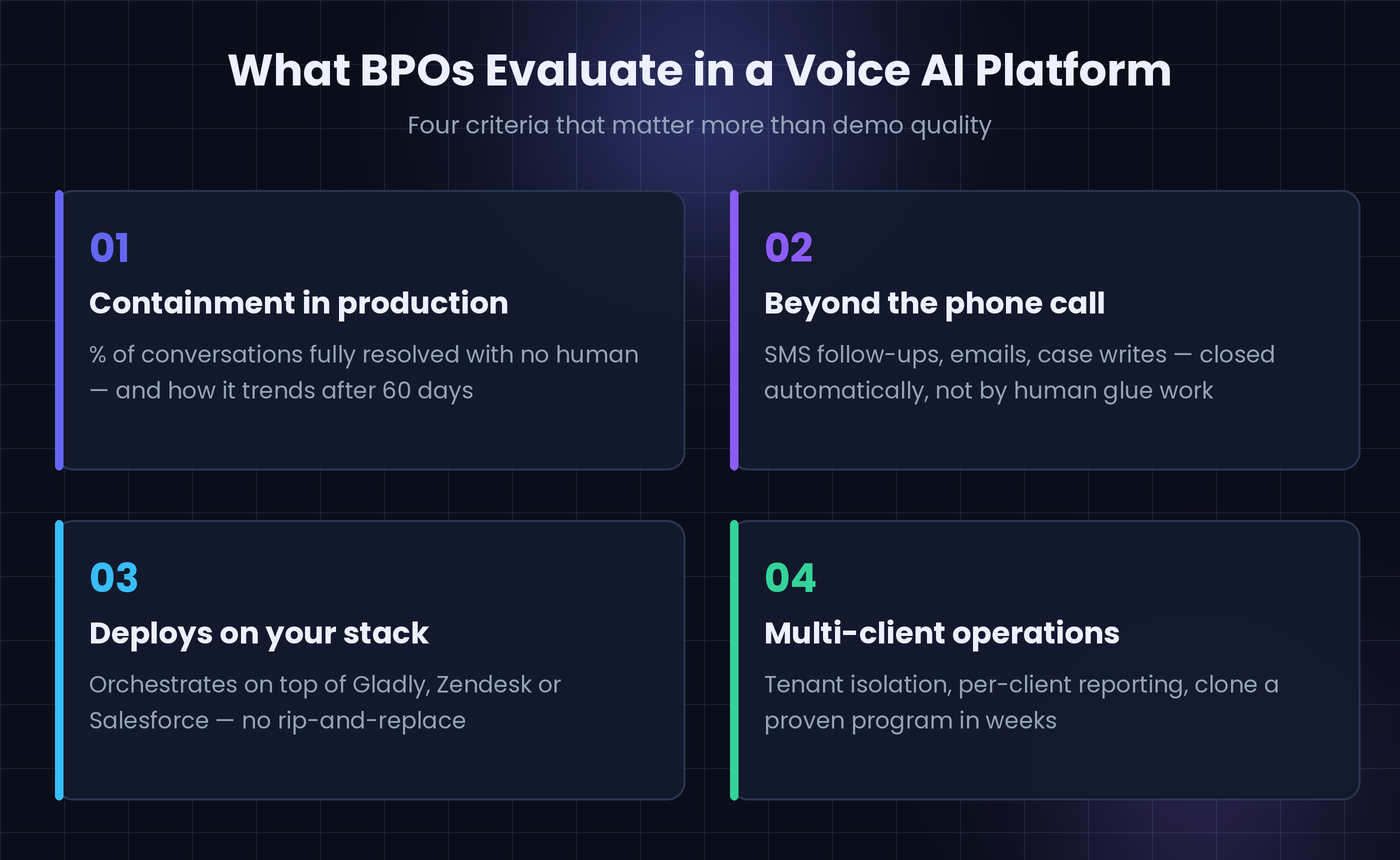
1. Containment and resolution, not demo quality
Every platform demos well in 2026. The separation shows up 60 days into production: what percentage of conversations are fully contained without a human, and how does that number trend as the system learns from real traffic? When evaluating vendors, ask for containment data from a live deployment in your industry, not a benchmark from a controlled test.
2. What happens beyond the phone call
Voice-only platforms end at the hang-up. In real CX operations, the conversation continues: a follow-up SMS, an email with a return label, a case created in the system of record. Platforms with native omnichannel orchestration close these loops automatically; voice-point-solutions push that work back onto human agents — which quietly erodes the ROI the voice bot was supposed to deliver.
3. Deploying on top of existing stacks
BPO clients rarely allow their system of record to be replaced. The practical question is whether the AI layer can orchestrate on top of Gladly, Zendesk, Salesforce, or a homegrown CRM without a rip-and-replace. This is a core architectural choice: Anyreach, for example, is designed to sit on top of the existing stack as the interaction layer, which is what makes 8-to-12-week client deployments realistic for BPO programs.
4. Multi-client operations
For a BPO, one deployment is really twenty deployments. Per-client agent configuration, isolated analytics, client-facing reporting, and the ability to clone a proven program for a new logo are the difference between AI as a margin engine and AI as a science project.
How BPOs Should Run the Evaluation
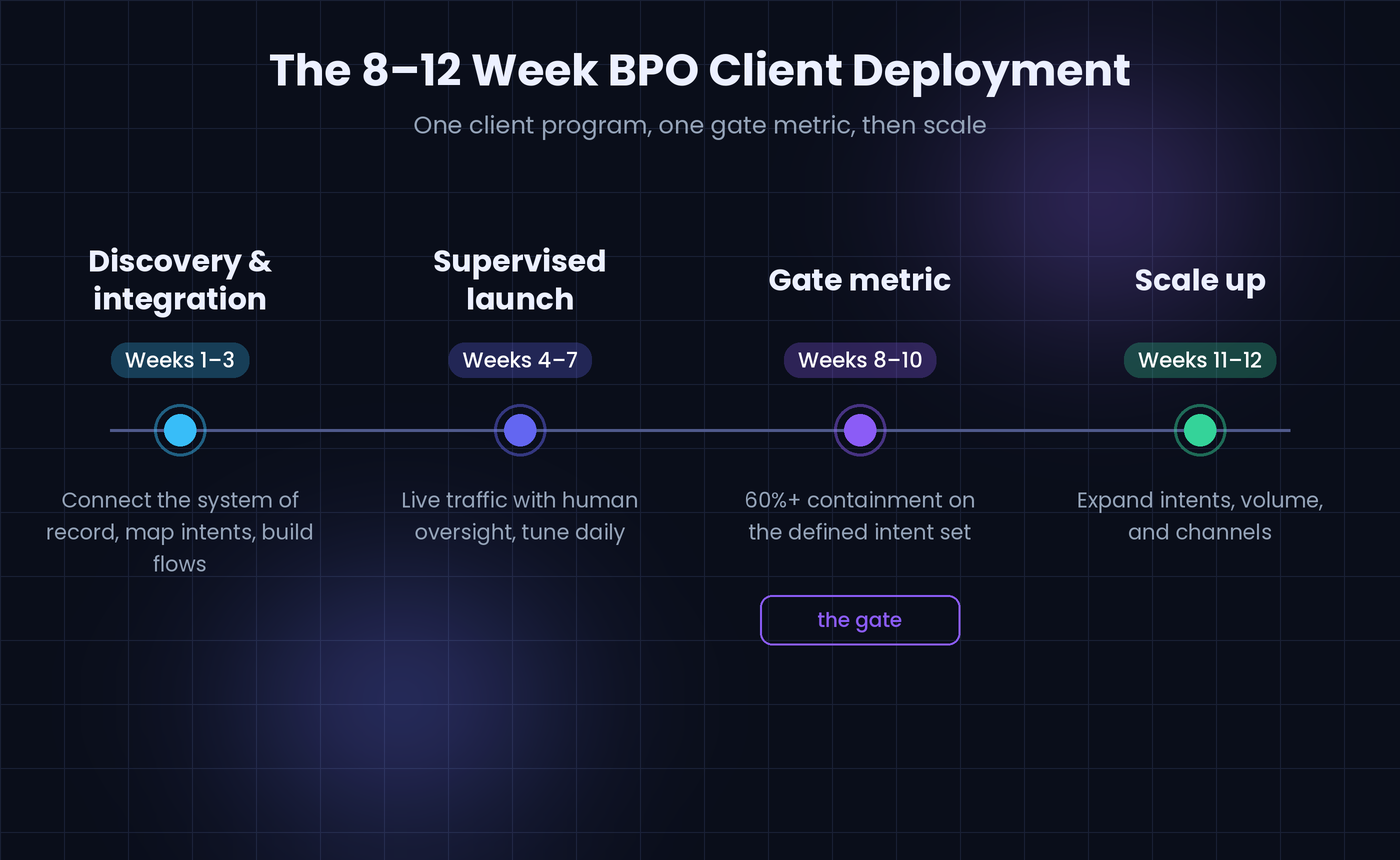
The pattern we see work: pick one client program with clear volume and a measurable containment target, run a 8–12 week phased deployment with a defined gate metric (for example, 60% chat or voice containment before expanding scope), and negotiate pricing that scales with resolved conversations rather than raw minutes. This keeps incentives aligned and gives you a defensible case study for the next client pitch — which, in the BPO business model, is where the real revenue multiplier lives.
If you want to see what that architecture looks like against your current stack, talk to our team or explore the omnichannel platform in detail.
Frequently Asked Questions
What is the best AI voice agent platform for BPOs in 2026?
It depends on the operating model. Developer-first APIs like Retell AI or Vapi suit teams building custom stacks in-house. For BPOs that need multi-client management, omnichannel follow-through, and deployment on top of existing systems of record, a full-stack platform like Anyreach is typically the stronger fit.
How long does it take a BPO to deploy an AI voice agent for a client?
With a platform that orchestrates on top of the existing system of record, a phased client deployment typically runs 8–12 weeks: discovery and integration, supervised launch, then scale-up once the containment gate metric is met.
Should BPOs choose per-minute or per-resolution pricing for voice AI?
Per-resolution or outcome-linked pricing generally aligns better with BPO economics, because it ties cost to delivered value rather than call duration. Per-minute pricing can penalize the longer, more complex calls where AI adds the most value.
Can AI voice agents work with systems like Gladly or Zendesk?
Yes — modern orchestration platforms deploy as an interaction layer on top of the existing system of record, reading and writing to it rather than replacing it. This is usually a hard requirement in BPO client environments.
See how Anyreach handles your call volume
Book a live demo with a real deployment, not a slide deck.
Talk to Us![[BPO Insights] Where We're Going: The Anyreach Vision for the Next 18 Months](https://storage.ghost.io/c/40/ac/40ac18d7-d0cb-4132-9e8b-e6740dedd4ad/content/images/size/w600/2026/02/05_the_2028_thesis-17.png)
![[BPO Insights] Mid-Year Performance Benchmarks in AI-Powered BPO Deployments](https://storage.ghost.io/c/40/ac/40ac18d7-d0cb-4132-9e8b-e6740dedd4ad/content/images/size/w600/2026/02/04_the_builders_log-17.png)
![[BPO Insights] Year 2 Revenue Scaling Patterns in the Small-to-Enterprise BPO Market](https://storage.ghost.io/c/40/ac/40ac18d7-d0cb-4132-9e8b-e6740dedd4ad/content/images/size/w600/2026/02/03_the_uncomfortable_math-17.png)
![[BPO Insights] The Warmest Introduction I've Ever Gotten Came From Our Smallest Customer](https://storage.ghost.io/c/40/ac/40ac18d7-d0cb-4132-9e8b-e6740dedd4ad/content/images/size/w600/2026/02/02_from_the_other_side-17.png)