
AI Customer Support Pricing in 2026: Per-Minute vs Per-Resolution vs Flat Fee
The three dominant AI support pricing models in 2026, who carries the risk in each, the two numbers that matter more than the rate card, and how to negotiate hybrid structures.


Last reviewed: July 2026
TL;DR
AI customer support is priced three ways in 2026: per-minute (buyer carries duration risk), per-resolution (vendor carries outcome risk), and flat platform fees (best at high stable volume and for multi-client BPOs). The pricing model matters less than two numbers: containment rate and how fast it improves in the first 90 days. Negotiate hybrid structures with containment gate clauses, and — for BPOs — portfolio-level multi-client rights.
Why AI Support Pricing Is Confusing on Purpose
Ask five vendors what AI customer support costs and you will get five incompatible answers: dollars per minute, dollars per resolution, dollars per conversation, platform fees plus usage, or a flat monthly subscription. Each model tells you what the vendor is optimizing for — and each one shifts risk between you and them differently. This guide breaks down the three dominant models in 2026, the math behind each, and how to pick the structure that matches your operation.
Model 1: Per-Minute Pricing
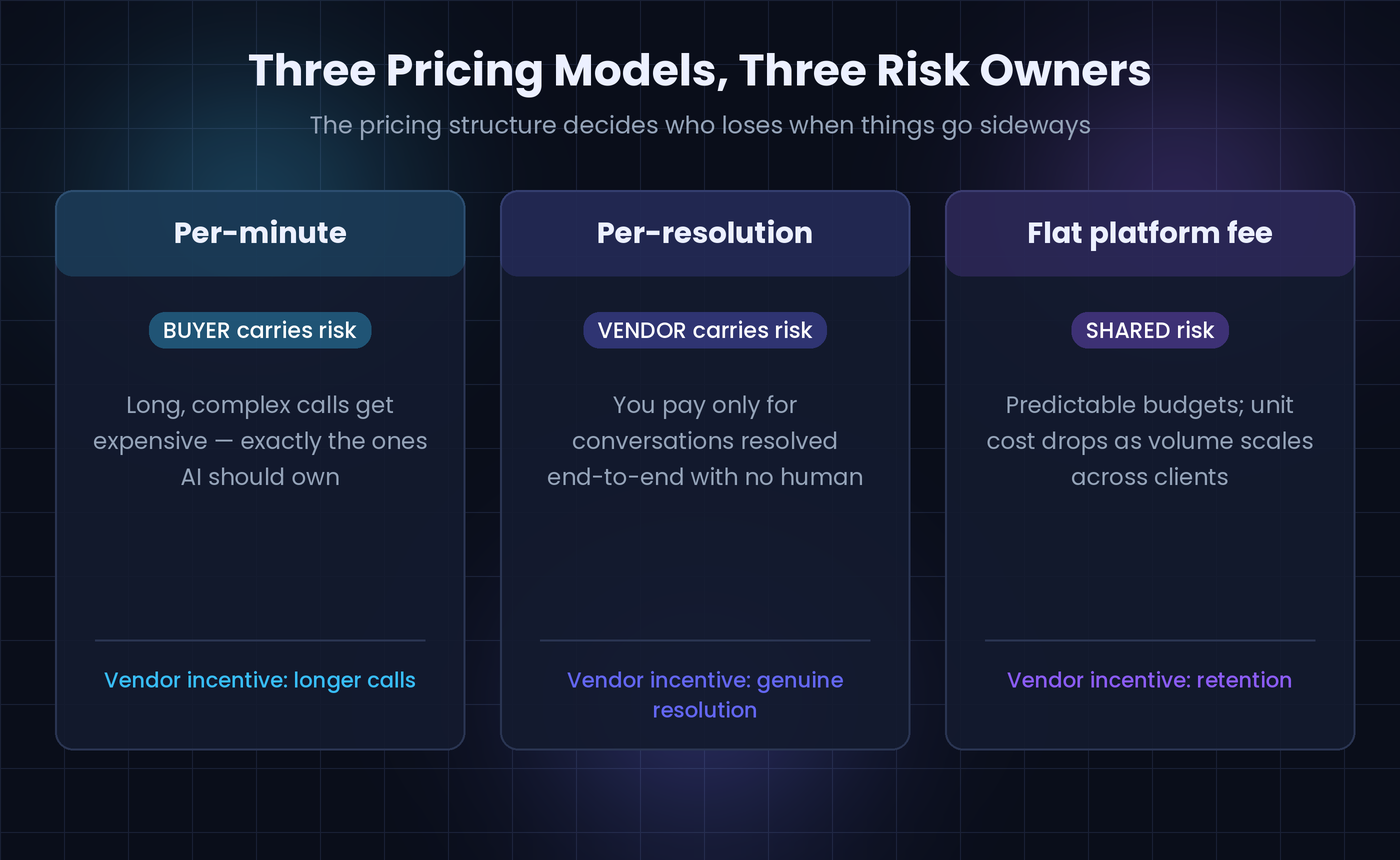
The legacy model, inherited from telephony. You pay for every minute an AI agent spends on a call, typically somewhere in the range of a few cents to around twenty cents per minute depending on model quality, telephony costs, and volume commitments.
Where it works: short, predictable call types — order status, appointment confirmation, simple FAQs — where duration is stable and low.
Where it breaks: complex support. The calls where AI creates the most value (multi-step troubleshooting, retention saves, claims intake) are the longest ones. Per-minute pricing financially punishes exactly the conversations you most want automated. It also gives the vendor zero incentive to resolve faster.
Model 2: Per-Resolution Pricing
You pay only when the AI fully resolves a conversation without human involvement — pricing commonly lands in the range of a fraction of what the equivalent human handle would cost. Intercom's Fin popularized the model in chat; it has since spread to voice.
Where it works: operations with a clear, auditable definition of "resolved," and leaders who want AI spend to map one-to-one to deflected workload. It is the cleanest ROI story to take to a CFO: every dollar spent replaced a measurable unit of human work.
Where it breaks: definition disputes. What counts as resolved? If a customer does not reply for 48 hours, is that resolution or abandonment? Contracts need explicit resolution criteria, audit rights, and a mechanism for clawing back misclassified outcomes.
Model 3: Platform / Flat-Fee Pricing
A fixed monthly or annual fee for the platform, sometimes with generous usage bands. Common with enterprise omnichannel suites.
Where it works: high, stable volume — the effective per-conversation cost drops as you scale, and budgeting is predictable. Also the natural fit for BPOs running many client programs on one platform, where per-unit metering across dozens of tenants becomes an accounting burden.
Where it breaks: low or spiky volume, where you pay for capacity you do not use.
The Comparison at a Glance
| Dimension | Per-minute | Per-resolution | Platform / flat fee |
|---|---|---|---|
| Risk sits with | Buyer (duration risk) | Vendor (outcome risk) | Shared (utilization risk) |
| Best for | Short, predictable calls | Clear deflection goals, CFO-friendly ROI | High stable volume, multi-client BPOs |
| Vendor incentive | Longer calls | Genuine resolution | Retention and expansion |
| Budget predictability | Low–medium | Medium | High |
| Watch out for | Complex calls getting expensive | Disputes over what counts as resolved | Paying for unused capacity |
The ROI Math That Actually Matters
Whatever the pricing model, the evaluation reduces to one comparison: fully-loaded cost per AI-resolved conversation vs. fully-loaded cost per human-resolved conversation. A human-handled support contact in most Western markets carries a fully-loaded cost several times higher than typical AI pricing under any of the three models — which is why the pricing model matters less than two operational numbers:
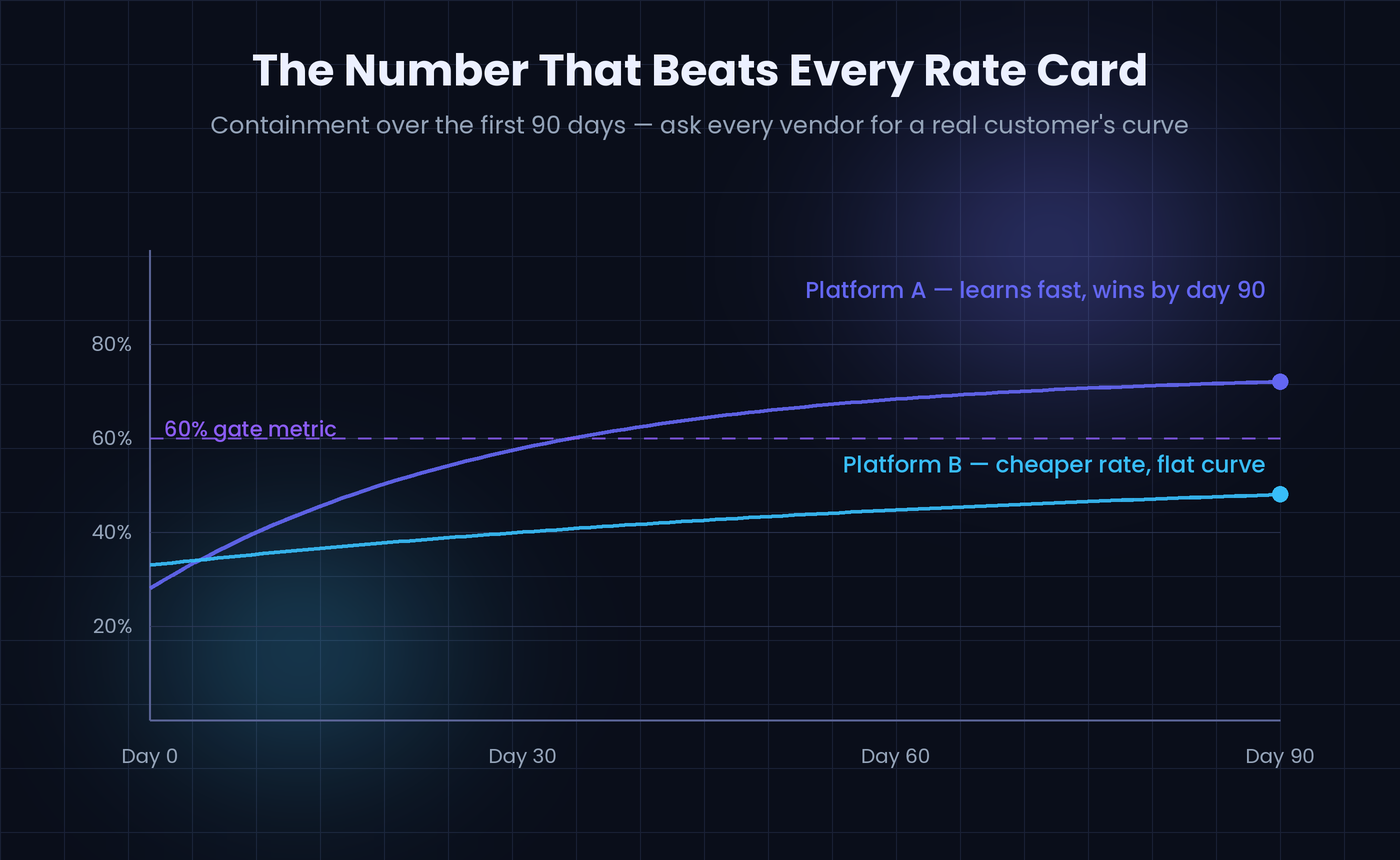
Containment rate — the percentage of conversations AI completes without human handoff. This is the multiplier on everything. A platform that costs more per unit but contains 70% of volume beats a cheaper one containing 40%.
Containment trajectory — how that number improves over the first 90 days as the system learns from production traffic. Ask every vendor for a real customer's week-by-week containment curve. The shape of that curve is more predictive than any pricing sheet.
How to Negotiate in 2026
The market is competitive enough that hybrid structures are normal. Patterns we see work well: a modest platform fee plus per-resolution pricing with a quarterly true-up; containment gate clauses (pricing tiers unlock as containment targets are met); and pilot pricing where the first 8–12 weeks run at reduced rates against an agreed gate metric — for example, 60% containment on a defined intent set — before the full commercial agreement kicks in.
For BPOs specifically: negotiate multi-client rights up front. The economics change completely when one platform agreement covers your whole client portfolio instead of being repriced per program. See how Anyreach structures pricing or talk to us about a portfolio-level agreement.
Frequently Asked Questions
How much does AI customer support cost in 2026?
It depends on the pricing model: per-minute voice pricing typically runs from a few cents to roughly twenty cents per minute; per-resolution pricing charges only for conversations AI fully resolves; platform models charge a flat fee with usage bands. The more useful metric is cost per AI-resolved conversation, which in most deployments lands well below the fully-loaded cost of a human-handled contact.
What is per-resolution pricing for AI support?
You pay only when the AI resolves a conversation end-to-end without human involvement. It aligns vendor incentives with outcomes, but contracts must define resolution precisely — including what happens when a customer simply stops replying.
Which pricing model is best for BPOs?
Usually a platform or hybrid model with multi-client rights, because BPOs run many programs on one deployment and per-unit metering across tenants becomes an accounting burden. Portfolio-level agreements also unlock better unit economics than repricing each client program.
What containment rate should we expect from AI customer support?
Mature deployments commonly reach 60–75% containment on well-scoped intent sets, but the starting point and trajectory vary by industry and data quality. Insist on seeing a real customer's containment curve over the first 90 days rather than a single headline number.
See how Anyreach handles your call volume
Book a live demo with a real deployment, not a slide deck.
Talk to Us![[BPO Insights] Where We're Going: The Anyreach Vision for the Next 18 Months](https://storage.ghost.io/c/40/ac/40ac18d7-d0cb-4132-9e8b-e6740dedd4ad/content/images/size/w600/2026/02/05_the_2028_thesis-17.png)
![[BPO Insights] Mid-Year Performance Benchmarks in AI-Powered BPO Deployments](https://storage.ghost.io/c/40/ac/40ac18d7-d0cb-4132-9e8b-e6740dedd4ad/content/images/size/w600/2026/02/04_the_builders_log-17.png)
![[BPO Insights] Year 2 Revenue Scaling Patterns in the Small-to-Enterprise BPO Market](https://storage.ghost.io/c/40/ac/40ac18d7-d0cb-4132-9e8b-e6740dedd4ad/content/images/size/w600/2026/02/03_the_uncomfortable_math-17.png)
![[BPO Insights] The Warmest Introduction I've Ever Gotten Came From Our Smallest Customer](https://storage.ghost.io/c/40/ac/40ac18d7-d0cb-4132-9e8b-e6740dedd4ad/content/images/size/w600/2026/02/02_from_the_other_side-17.png)