
Best AI Customer Support Platforms for Ecommerce in 2026
WISMO, returns and cancellations decide ecommerce support ROI. How six AI platforms compare on order actions, intent-level containment, peak elasticity, and revenue recovery.


Last reviewed: July 2026
TL;DR
Ecommerce support is dominated by three intents — WISMO, returns, cancellations — arriving in huge, spiky volume. Platforms separate on four capabilities: real order actions (not just answers), intent-level containment on the big three, peak elasticity without punitive pricing, and turning support into revenue recovery. Gorgias fits Shopify-first brands; Fin and Zendesk AI fit their own ecosystems; Anyreach fits teams orchestrating all channels on top of an existing system of record.
Why Ecommerce Support Is Its Own Problem
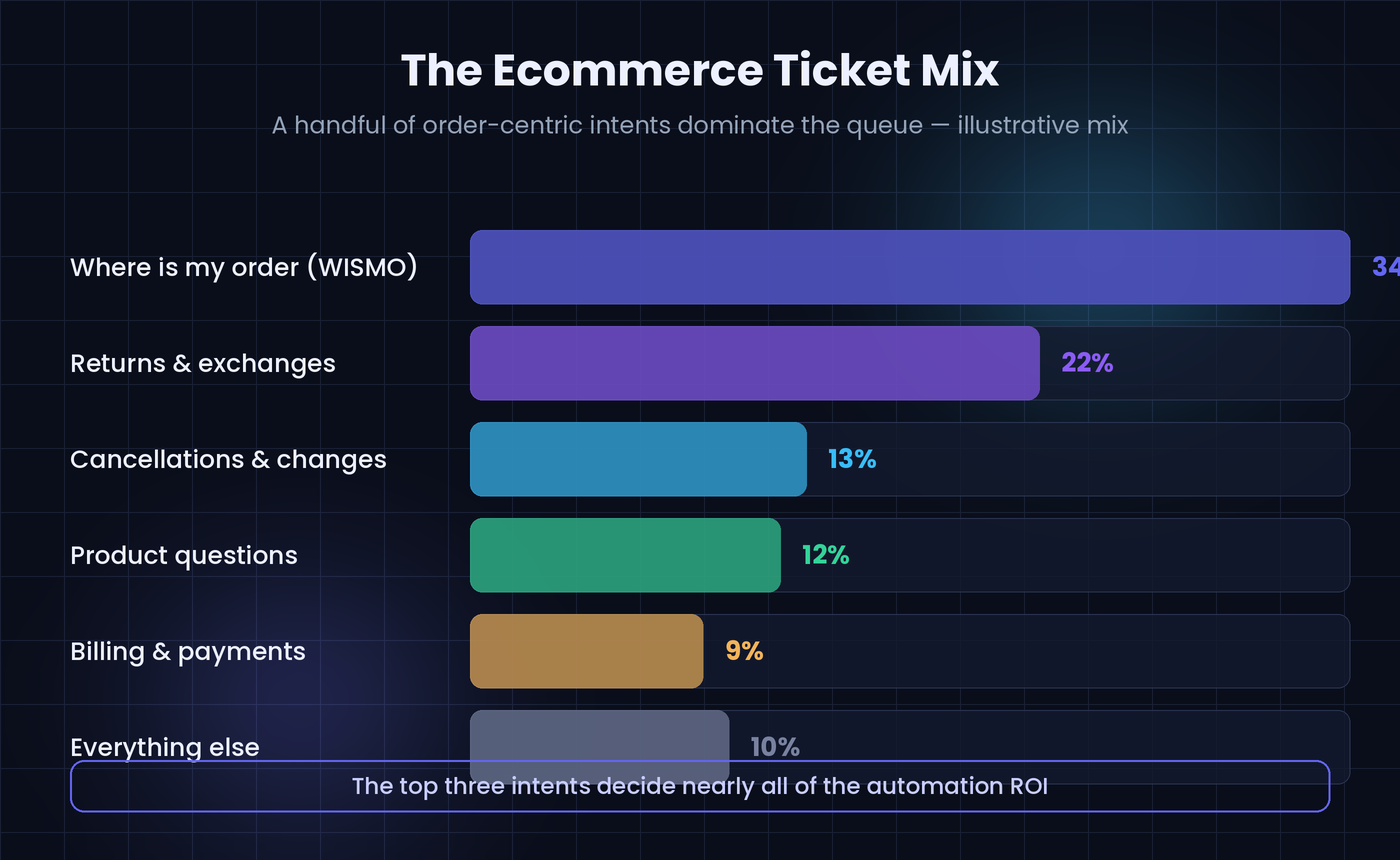
Ecommerce support has a shape unlike any other industry. The ticket mix is dominated by a handful of repetitive, order-centric intents — where is my order, returns and exchanges, cancellations, address changes — that are individually simple but arrive in enormous volume. Then, several times a year, that volume multiplies: sale events, holiday peaks, and shipping cutoffs turn a manageable queue into a fire. Hiring for the peak means overstaffing the rest of the year; staffing for the average means drowning in November.
This shape is exactly what AI handles best: high-volume, well-defined intents grounded in order data. The differences between platforms show up in how deeply they connect to the commerce stack — and what happens to the conversations that go beyond a tracking number.
The Platforms Ecommerce Teams Shortlist in 2026
| Platform | Best for | Channels | Commerce-stack depth | Model |
|---|---|---|---|---|
| Anyreach | Brands and BPOs running voice + chat + SMS + email on one orchestration layer, deployed on top of the existing helpdesk | Voice, chat, SMS, email | Integrates with the system of record (Gladly, Zendesk and others) and order systems; automates follow-through, not just answers | Managed platform |
| Gorgias | Shopify-centric brands consolidating helpdesk + automation | Chat, email, some voice | Deep Shopify native integration | Self-serve SaaS |
| Intercom Fin | Teams already on Intercom wanting resolution-priced chat AI | Chat, email | Good app ecosystem; commerce depth via integrations | Per-resolution |
| Zendesk AI | Zendesk shops adding AI to existing workflows | Chat, email, voice add-ons | Strong within Zendesk's own ecosystem | Seat + usage |
| Decagon | Enterprise brands with custom AI agent requirements | Chat, email, voice | Custom integrations, services-heavy | Enterprise |
| Gladly Sidekick | Gladly customers extending the platform natively | Chat, email | Native to Gladly | Platform add-on |
The Four Capabilities That Actually Separate Platforms
1. Order-data grounding
"Where is my order" is only automatable if the AI can read the order management system in real time and act on it — issue the refund, trigger the reshipment, update the address. Platforms that merely answer from a knowledge base deflect the easy half of the ticket and bounce the actionable half to a human. When evaluating, ask specifically: which order actions can the AI complete, not just explain?
2. Containment on the big three intents
WISMO, returns, and cancellations typically make up the majority of an ecommerce queue. Containment on those three intents determines nearly all of the ROI. Ask vendors for intent-level containment data from a live commerce deployment — a blended number hides weak spots exactly where volume is highest.
3. Peak elasticity
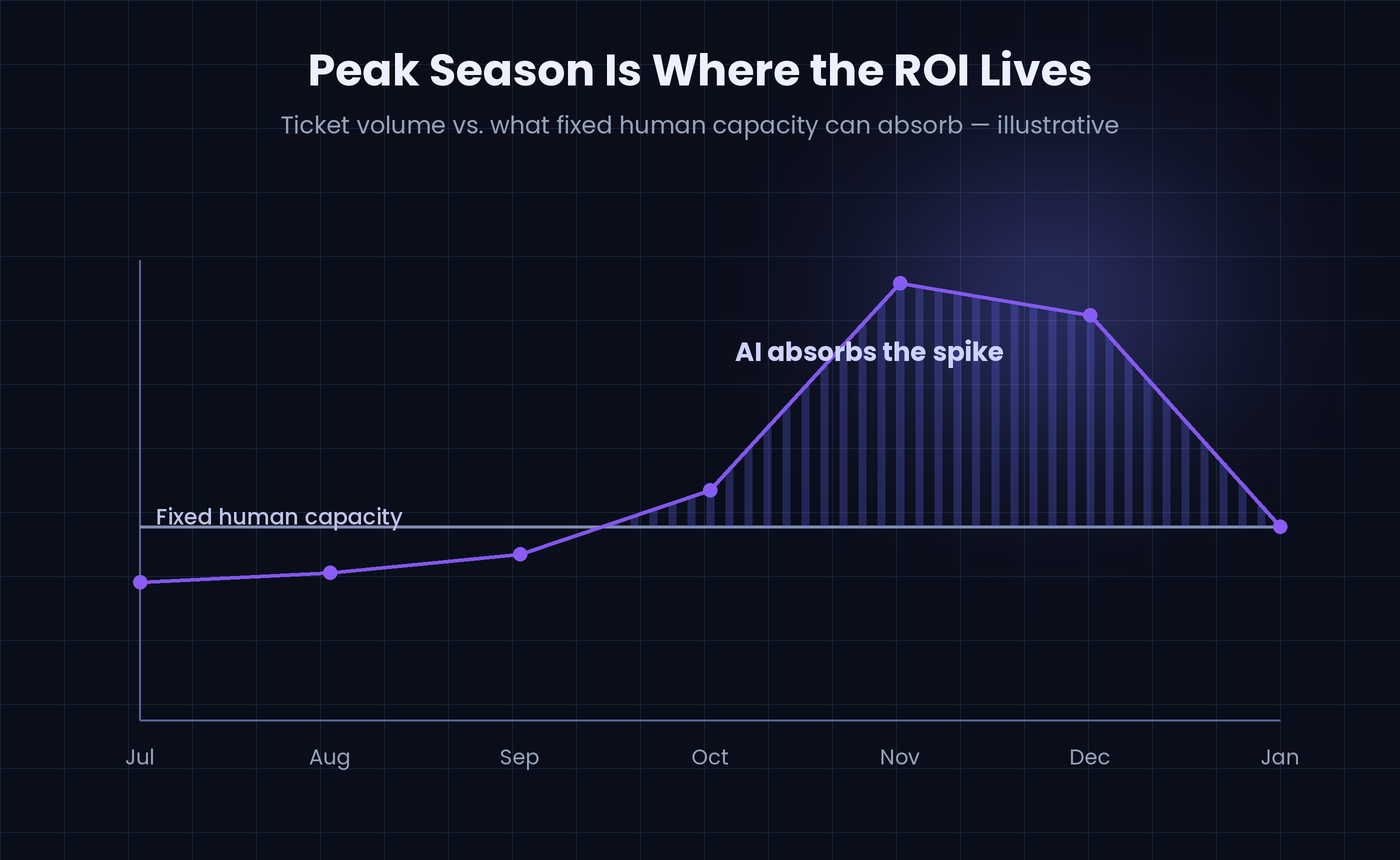
The economic case for AI in ecommerce is strongest during peaks, when the alternative is seasonal hiring and training. A platform needs to absorb 5–10x volume without degradation, and its pricing model needs to not punish you for the spike — this is where per-resolution or platform pricing usually beats per-conversation metering. We break the models down in our AI support pricing guide.
4. Revenue conversations, not just cost deflection
Support conversations in commerce are sales conversations in disguise: exchanges instead of refunds, save-flows on cancellations, restock notifications that convert. Platforms that treat support as a revenue surface — across chat, SMS and email follow-ups — change the business case from cost-cutting to margin recovery.
How to Run the Evaluation
Scope a pilot to the big three intents on one channel, run it on live traffic for 4–6 weeks before your next peak, and gate expansion on intent-level containment. If your stack is built around a system of record you don't want to replace, prioritize platforms that deploy as an orchestration layer on top of it — the pattern we outlined in our BPO platform comparison applies to brands just as much.
See how this looks against your stack on the Anyreach ecommerce page, or book a walkthrough with a live commerce deployment.
Frequently Asked Questions
What is the best AI customer support platform for ecommerce in 2026?
It depends on your stack: Gorgias fits Shopify-centric brands, Intercom Fin and Zendesk AI fit teams already on those helpdesks, and orchestration platforms like Anyreach fit brands and BPOs that want voice, chat, SMS and email automated on top of their existing system of record with real order actions.
Can AI handle 'where is my order' tickets end to end?
Yes, when it is grounded in the order management system — reading live order status and completing actions like refunds, reshipments and address changes. Knowledge-base-only bots answer the question but still hand the action to a human.
How does AI support handle peak season volume?
AI absorbs volume elastically, which is precisely where the ecommerce ROI concentrates: peaks that would otherwise require seasonal hiring. Confirm the platform's pricing model doesn't penalize spikes — per-resolution or platform pricing usually fits peaks better than per-conversation metering.
Should ecommerce brands replace their helpdesk to add AI?
Usually no. Orchestration platforms deploy on top of systems like Gladly or Zendesk, reading and writing to them rather than replacing them — which keeps history, workflows and reporting intact.
See how Anyreach handles your call volume
Book a live demo with a real deployment, not a slide deck.
Talk to Us![[BPO Insights] Where We're Going: The Anyreach Vision for the Next 18 Months](https://storage.ghost.io/c/40/ac/40ac18d7-d0cb-4132-9e8b-e6740dedd4ad/content/images/size/w600/2026/02/05_the_2028_thesis-17.png)
![[BPO Insights] Mid-Year Performance Benchmarks in AI-Powered BPO Deployments](https://storage.ghost.io/c/40/ac/40ac18d7-d0cb-4132-9e8b-e6740dedd4ad/content/images/size/w600/2026/02/04_the_builders_log-17.png)
![[BPO Insights] Year 2 Revenue Scaling Patterns in the Small-to-Enterprise BPO Market](https://storage.ghost.io/c/40/ac/40ac18d7-d0cb-4132-9e8b-e6740dedd4ad/content/images/size/w600/2026/02/03_the_uncomfortable_math-17.png)
![[BPO Insights] The Warmest Introduction I've Ever Gotten Came From Our Smallest Customer](https://storage.ghost.io/c/40/ac/40ac18d7-d0cb-4132-9e8b-e6740dedd4ad/content/images/size/w600/2026/02/02_from_the_other_side-17.png)