
AI Voice Agents for Insurance in 2026: Use Cases, Compliance, and ROI
The insurance use cases that work in production, the compliance questions that decide the deal, and where voice AI ROI actually concentrates for carriers, MGAs and BPOs.

Last reviewed: July 2026
TL;DR
Insurance call volume is mostly procedural — claim status, FNOL, policy servicing, billing — which is exactly what voice AI automates well, provided compliance is designed in: AI disclosure and consent as policy, conversation-level audit trails, SOC 2 baseline security, and structured human escalation. ROI concentrates in after-hours coverage, event-driven peaks, and freeing licensed agents from status calls.
Why Insurance Call Volume Fits Voice AI
Insurance contact centers live with a paradox: most calls are procedural — claim status, policy servicing, billing, ID cards, first notice of loss intake — yet every one of them carries compliance weight and, often, a stressed caller. The volume says automate; the stakes say be careful. That tension is exactly what modern voice AI is built for: handle the procedural majority end to end, capture everything cleanly for audit, and hand off the sensitive minority to a human with full context instead of a cold transfer.
The Use Cases That Work in Production
| Use case | What the AI does | Why it suits automation |
|---|---|---|
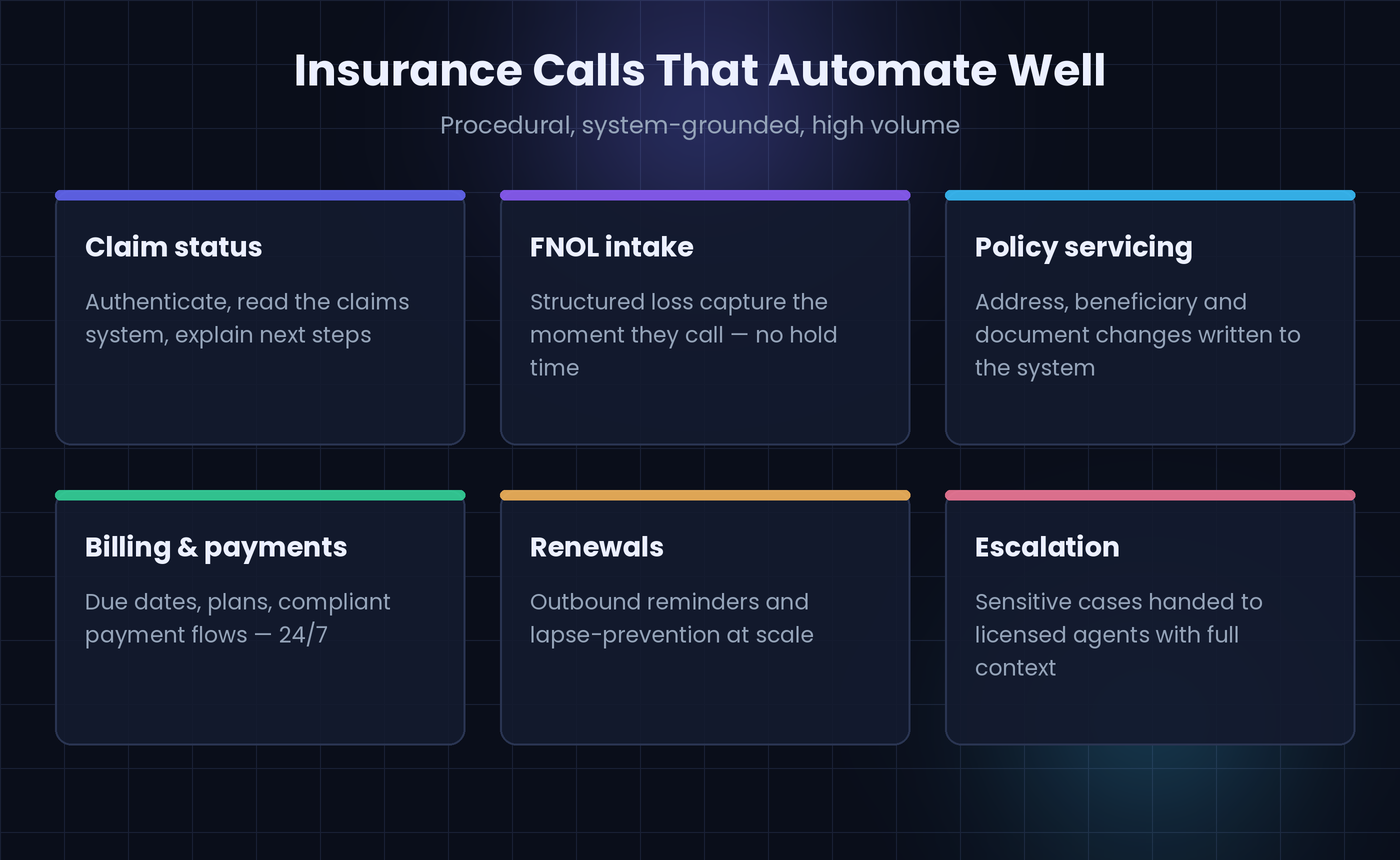
| Claim status | Authenticates the caller, reads the claims system, explains status and next steps | High volume, fully procedural, grounded in system data |
| FNOL intake | Structured first-notice-of-loss capture: parties, incident details, photos via SMS follow-up | Consistent intake quality; no hold time at the moment of stress |
| Policy servicing | Address changes, beneficiary updates, coverage questions, document requests | Well-defined actions written straight to the policy admin system |
| Billing & payments | Due dates, payment plans, taking payments over compliant flows | Repetitive, rules-based, high after-hours demand |
| Renewals & retention | Outbound renewal reminders, lapse-prevention outreach, callback scheduling | Timely outbound at scale that humans rarely get to |
The Compliance Questions That Decide the Deal
Insurance buyers evaluate voice AI through a compliance lens first, and rightly so. The questions that matter in 2026:
Consent and disclosure
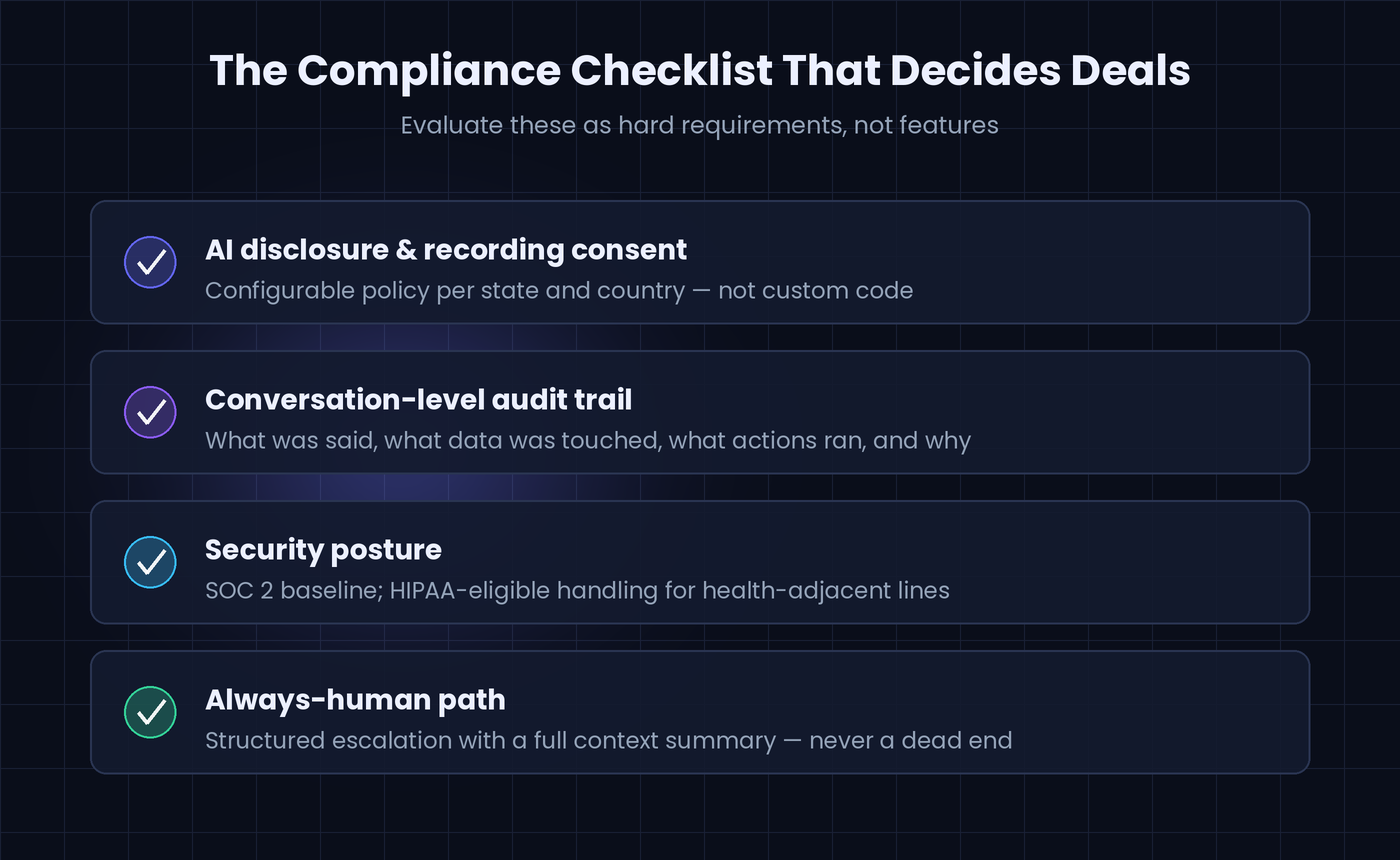
Call recording consent rules vary by state and country, and AI disclosure requirements are tightening — several US states now require informing callers they are speaking with an AI system. The platform should handle disclosure and consent capture as configurable policy, not custom code.
Auditability
Every automated conversation needs a complete, reviewable record: what was said, what data was accessed, what actions were taken, and why the AI decided what it decided. In a regulated environment, "the model handled it" is not an answer an auditor accepts — conversation-level traceability is the requirement.
Data handling and security posture
Ask where voice data is processed and stored, what is retained and for how long, and for the vendor's security attestations (SOC 2 is the practical baseline — Anyreach, for example, maintains SOC 2 compliance). For health-adjacent lines, HIPAA-eligible handling of any PHI that surfaces in calls becomes a hard requirement.
Escalation design
Regulators and CX leaders converge on the same principle: callers must always have a clear path to a human. Well-designed deployments treat escalation as a feature — the AI hands off with a structured summary, so the licensed agent starts with context instead of asking the caller to repeat everything.
The ROI Shape in Insurance
Insurance voice AI ROI concentrates in three places: after-hours coverage (claims don't wait for business hours, and FNOL captured at 2 AM is FNOL not lost to a competitor's adjuster), peak absorption around weather events and renewal cycles, and handle-time recovery for licensed agents who stop spending their day on status reads. The pattern that works is the same phased approach we describe in our platform comparison: one line of business, one intent set, a containment gate, then scale. Pricing structure matters too — for spiky, event-driven volume, see our breakdown of pricing models.
If you're evaluating voice AI for an insurance book — carrier, MGA, or the BPO serving them — talk to our team about a compliance-first deployment on top of your existing systems.
Frequently Asked Questions
Can AI voice agents handle insurance claims calls?
Yes — claim status, FNOL intake, policy servicing and billing are procedural, system-grounded calls that voice AI handles end to end in production, with structured escalation to licensed agents for sensitive or complex cases.
Are AI voice agents compliant for insurance use?
They can be, if deployed correctly: configurable AI disclosure and recording consent, complete conversation-level audit trails, SOC 2 (and where relevant HIPAA-eligible) data handling, and an always-available path to a human. Evaluate these as hard requirements, not features.
What is FNOL automation?
First-notice-of-loss automation uses an AI agent to capture structured incident details the moment a policyholder calls — parties, time, damage description, even photo collection via SMS follow-up — eliminating hold time at the most stressful moment and improving intake consistency.
Do callers have to be told they're talking to an AI?
Increasingly yes — several jurisdictions require AI disclosure, and the regulatory direction is clearly toward it. Platforms should treat disclosure as configurable policy so deployments stay compliant as rules evolve.
See how Anyreach handles your call volume
Book a live demo with a real deployment, not a slide deck.
Talk to Us![[BPO Insights] Where We're Going: The Anyreach Vision for the Next 18 Months](https://storage.ghost.io/c/40/ac/40ac18d7-d0cb-4132-9e8b-e6740dedd4ad/content/images/size/w600/2026/02/05_the_2028_thesis-17.png)
![[BPO Insights] Mid-Year Performance Benchmarks in AI-Powered BPO Deployments](https://storage.ghost.io/c/40/ac/40ac18d7-d0cb-4132-9e8b-e6740dedd4ad/content/images/size/w600/2026/02/04_the_builders_log-17.png)
![[BPO Insights] Year 2 Revenue Scaling Patterns in the Small-to-Enterprise BPO Market](https://storage.ghost.io/c/40/ac/40ac18d7-d0cb-4132-9e8b-e6740dedd4ad/content/images/size/w600/2026/02/03_the_uncomfortable_math-17.png)
![[BPO Insights] The Warmest Introduction I've Ever Gotten Came From Our Smallest Customer](https://storage.ghost.io/c/40/ac/40ac18d7-d0cb-4132-9e8b-e6740dedd4ad/content/images/size/w600/2026/02/02_from_the_other_side-17.png)