
[OpenClaw] OpenClaw vs Enterprise AI Agents: What's the Difference and Why It Matters
Understand the critical differences between OpenClaw's open-source AI agent and enterprise AI agent platforms. Security, compliance, scalability, and support compared.

![[OpenClaw] OpenClaw vs Enterprise AI Agents: What's the Difference and Why It Matters](/content/images/size/w1200/2026/02/Anyreach-Openclaw-Blog-Cover--4-.png)
Two Approaches to the Same Vision
OpenClaw and enterprise AI agent platforms share a common vision: AI that does not just chat but actually takes action. Both connect large language models to real-world tools and communication channels. Both aim to automate tasks that consume hours of human time. And both represent the agentic AI wave that is transforming how work gets done.
But the similarities end at the vision. The architecture, security model, operational characteristics, and intended use cases diverge fundamentally. Understanding these differences is essential for any organization evaluating how to deploy AI agents, whether they are considering OpenClaw directly, worrying about employees adopting it, or exploring enterprise alternatives.
Architecture and Deployment
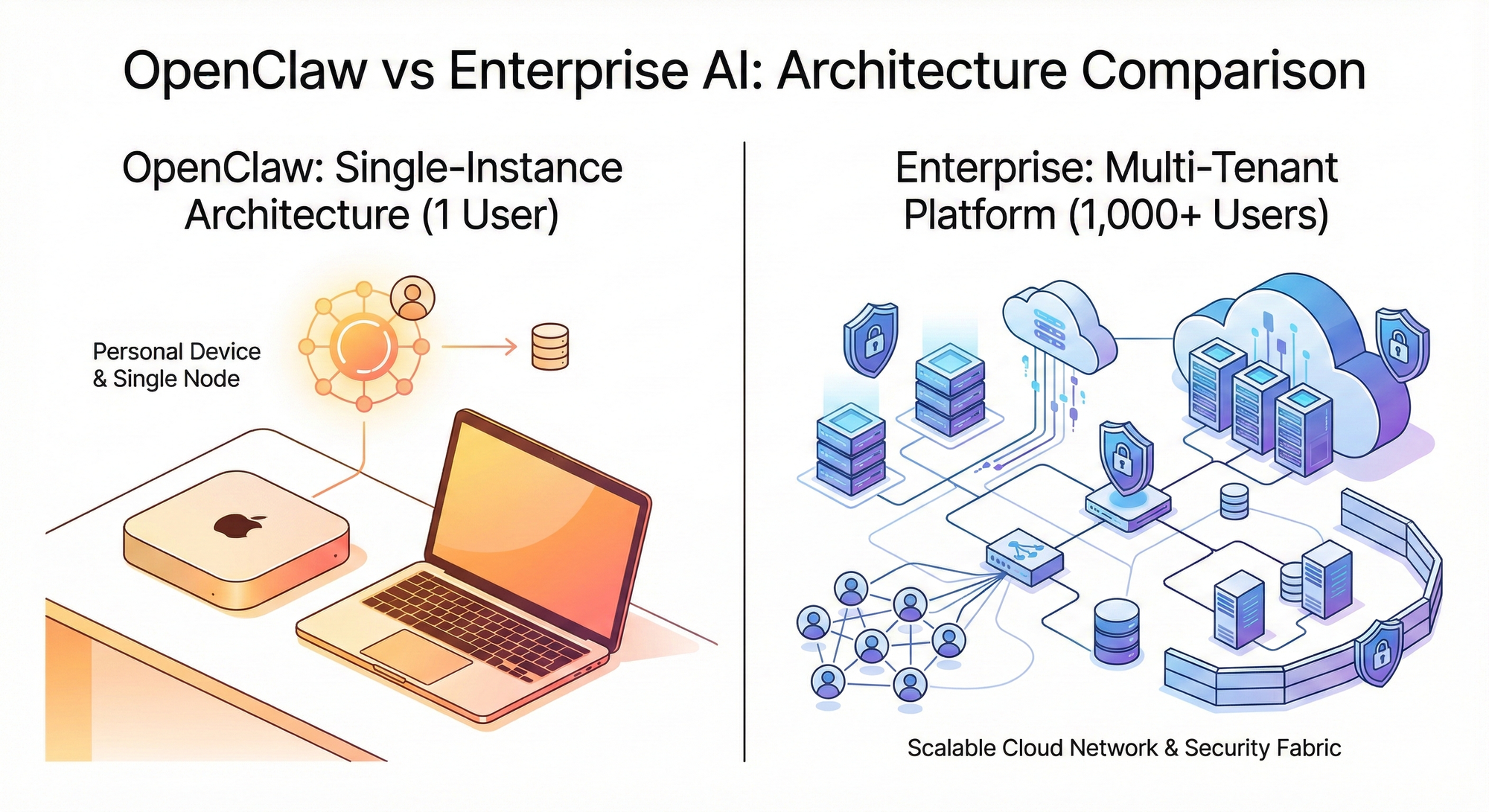
OpenClaw runs as a single instance on personal hardware. You install it on a Mac Mini, a Linux server, or a VPS, and it operates as your personal AI assistant. This architecture is elegant for individual use. One person, one agent, one machine.
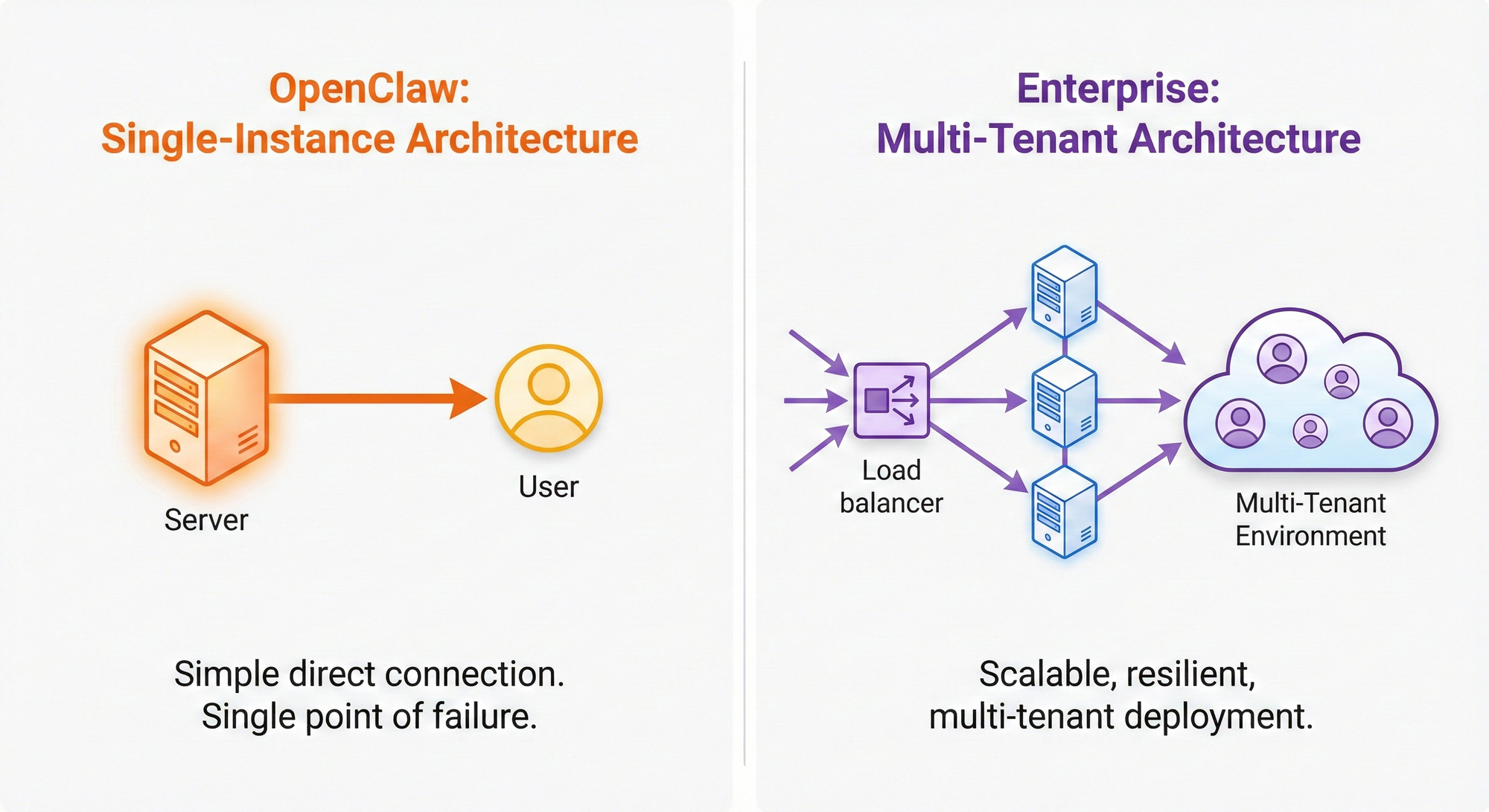
Enterprise AI agent platforms operate on fundamentally different architecture. They are multi-tenant by design, supporting hundreds or thousands of concurrent agent interactions across an organization. They run on redundant cloud infrastructure with automatic failover, load balancing, and horizontal scaling. When a contact center needs to handle a spike of ten thousand customer interactions simultaneously, the platform scales to meet demand without any single point of failure.
This architectural difference matters enormously in practice. An OpenClaw instance that crashes at 3 AM restarts when you notice it. An enterprise platform that experiences an issue triggers automated recovery, alerts operations teams, and maintains service continuity because customer-facing operations cannot tolerate downtime.
Security and Data Governance
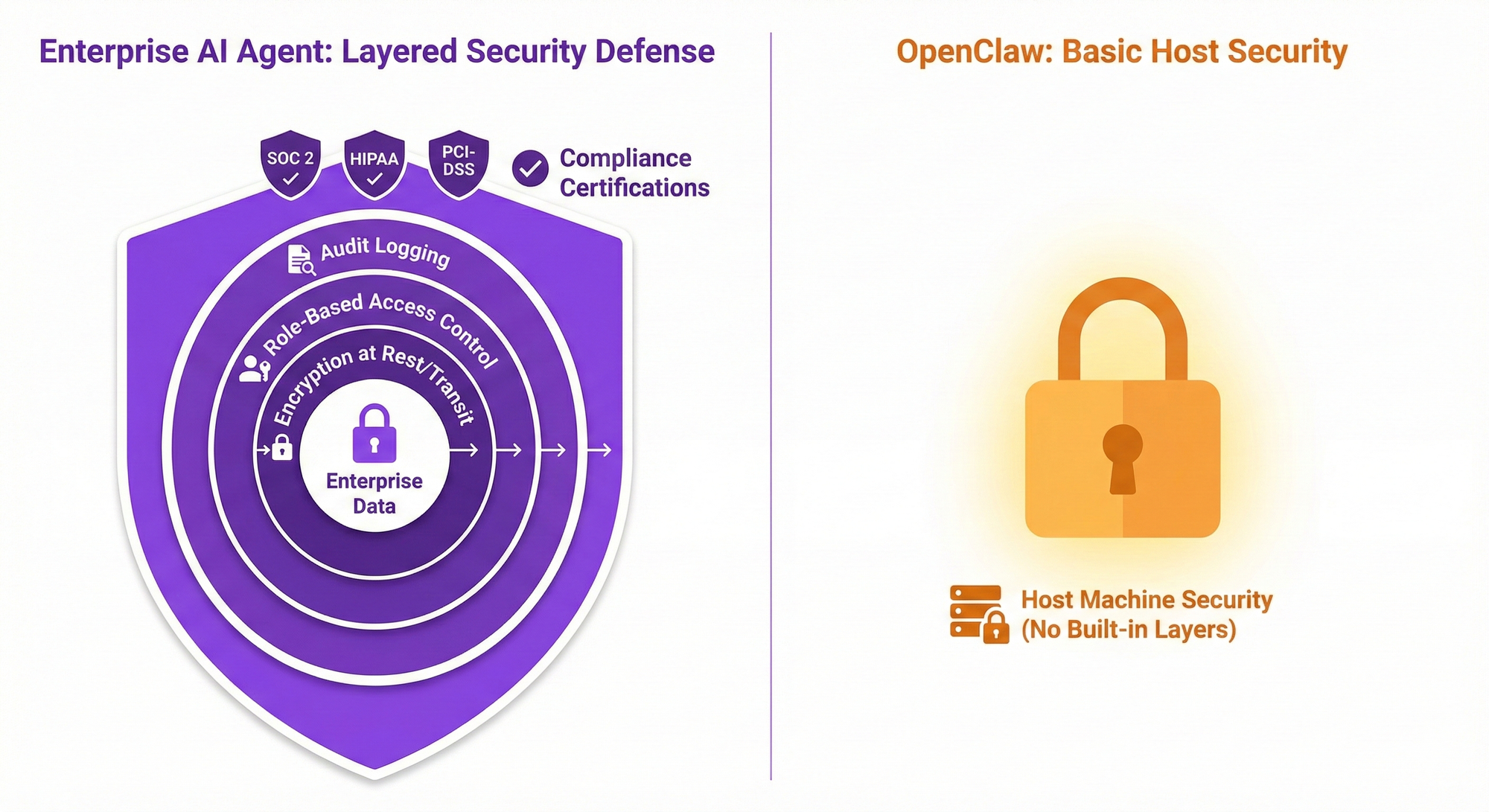
OpenClaw's security model is essentially the security posture of whatever machine it runs on. If your Mac Mini has full disk encryption and sits behind a firewall, your OpenClaw instance inherits that protection. If it does not, your AI agent and everything it accesses is as vulnerable as that machine.
Enterprise AI agent platforms implement defense-in-depth security architectures. Data encryption at rest and in transit, role-based access controls, network segmentation, regular penetration testing, and security certifications like SOC 2 Type II are standard. Data governance features include retention policies, data residency controls, PII redaction, and comprehensive audit logging of every action the AI agent takes.
For organizations in regulated industries, this difference is not optional. A healthcare company deploying AI agents for patient communication needs HIPAA-compliant infrastructure, business associate agreements, and audit trails that demonstrate exactly what data the AI accessed and what actions it took. A financial services firm needs PCI-DSS compliance for any agent handling payment information. OpenClaw does not provide any of this infrastructure, and building it on top of a self-hosted instance would require a dedicated engineering team.
Scalability and Reliability
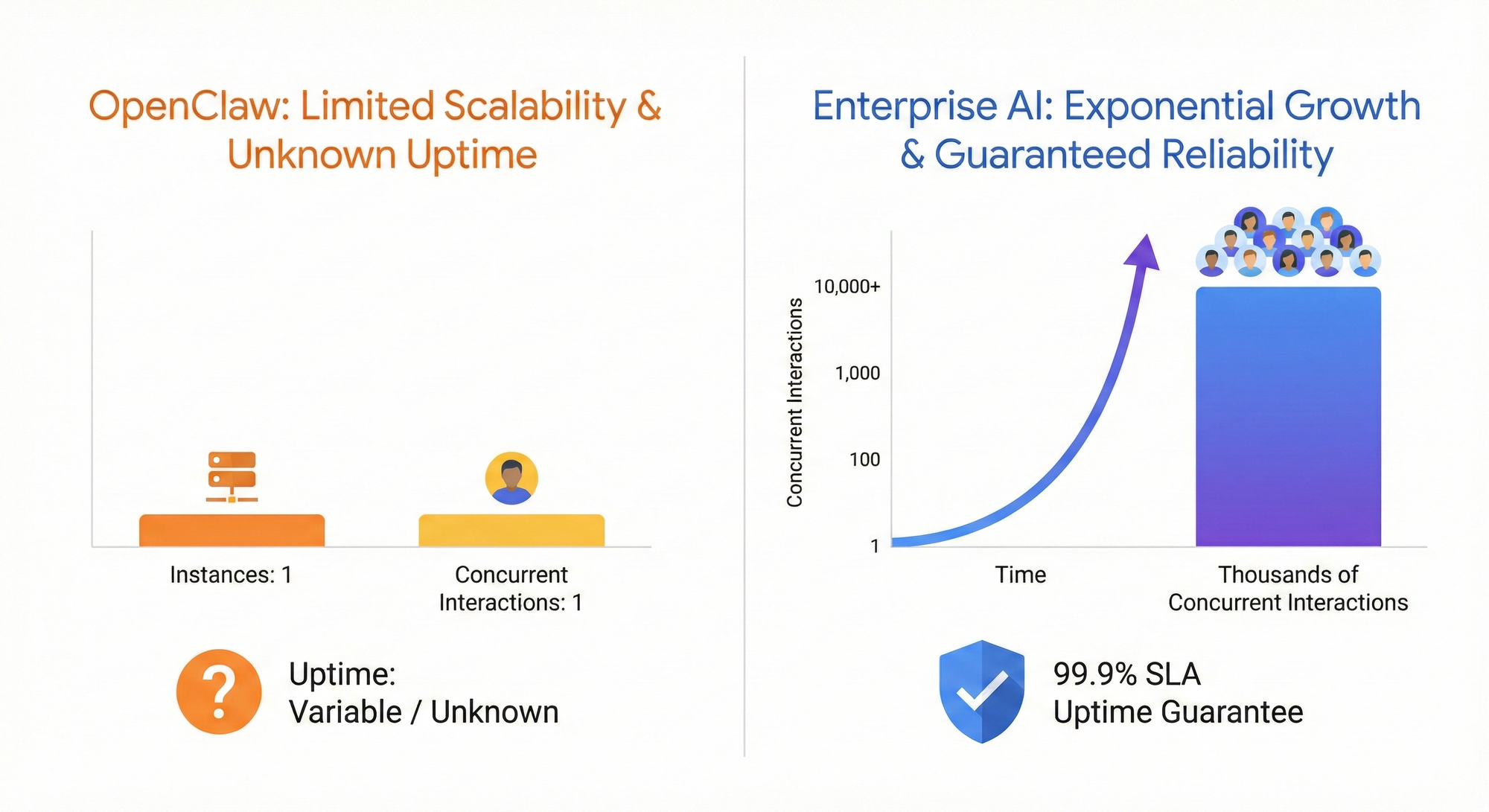
An individual OpenClaw instance handles one user's tasks on one machine. Scaling to support a team of fifty people means running fifty instances, each requiring individual configuration, monitoring, and maintenance. Scaling to support customer-facing operations handling thousands of daily interactions is simply not within the design parameters.
Enterprise platforms are engineered for scale from the ground up. Anyreach, for example, supports omnichannel AI agent operations across voice, chat, SMS, WhatsApp, and email simultaneously, handling thousands of concurrent interactions with consistent response quality. The platform manages model orchestration, conversation state, channel routing, and escalation logic at scale — capabilities that would require significant custom engineering to replicate.
Reliability follows a similar pattern. Enterprise platforms offer SLA-backed uptime guarantees, redundant infrastructure, and dedicated support. An OpenClaw instance offers the reliability of whatever hardware and network connection you provide, with community forums as your support channel.
Integration Depth and Channel Coverage
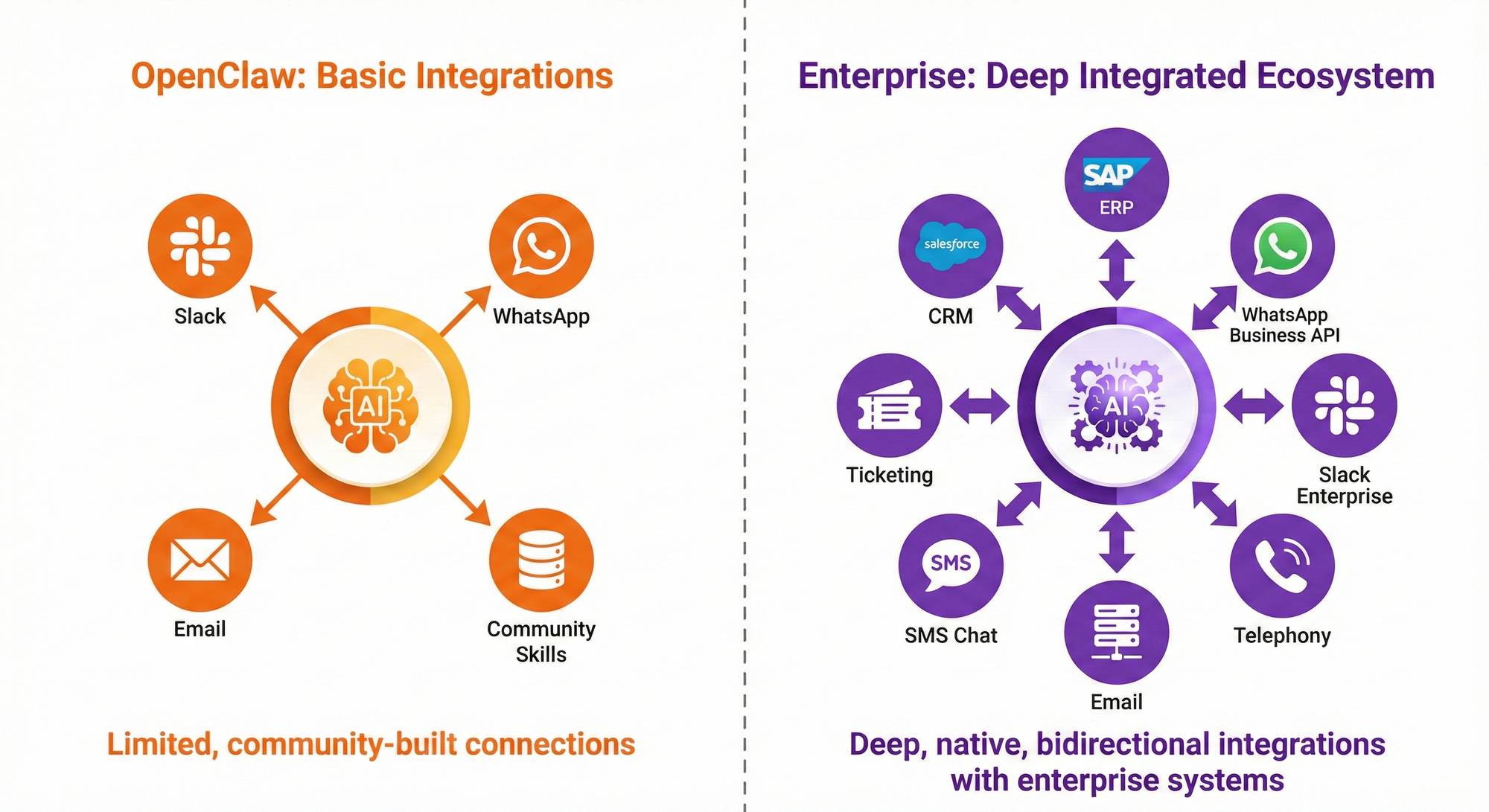
OpenClaw connects to messaging platforms like WhatsApp, Telegram, and Slack through community-built skills. These integrations are functional for personal use but vary in reliability, maintenance status, and feature completeness.
Enterprise platforms provide deeply integrated, professionally maintained channel connections. This includes native telephony integration for voice AI agents, bidirectional SMS, official WhatsApp Business API integration, live chat widgets, and email processing. Beyond channels, enterprise platforms integrate with CRM systems, ticketing platforms, knowledge bases, and existing contact center infrastructure.
The depth of integration matters for business operations. An enterprise AI agent that handles a customer call needs to pull context from the CRM, check order status in the ERP, create a ticket in the helpdesk system, and update the customer record — all within the same interaction, with full logging and error handling.
The Bottom Line
OpenClaw is an impressive project that has legitimately advanced the conversation about what AI agents can do. For individual developers and power users who want a hackable, personal AI assistant, it delivers genuine value.
But enterprise deployment requires a fundamentally different set of capabilities. Security, compliance, scalability, reliability, multi-channel orchestration, and professional support are not features you bolt on after the fact. They need to be architectural foundations.
Organizations evaluating AI agent deployment should consider purpose-built enterprise platforms that deliver the action-taking capabilities OpenClaw has popularized, within the governance framework that business operations demand.
Frequently Asked Questions
Can OpenClaw be used in an enterprise setting?
While technically possible, OpenClaw lacks the security controls, compliance frameworks, multi-tenant architecture, and reliability guarantees that enterprise deployments require. Organizations in regulated industries face particular challenges as OpenClaw provides no built-in HIPAA, PCI-DSS, or SOC 2 compliance capabilities.
What is an enterprise AI agent platform?
An enterprise AI agent platform is a managed, scalable solution that deploys autonomous AI agents across business communication channels with built-in security, compliance, audit logging, and integration with enterprise systems. These platforms handle thousands of concurrent interactions with SLA-backed reliability.
Is OpenClaw a competitor to enterprise AI agent platforms?
Not directly. OpenClaw serves individual users and developers who want a personal AI assistant. Enterprise AI agent platforms serve organizations that need to deploy AI agents at scale for customer-facing or internal operations with governance and compliance requirements.
Ready for Enterprise-Grade AI Agents?
Anyreach delivers the agentic AI capabilities your organization needs with the security, compliance, and scalability enterprise operations demand. See how Anyreach can transform your customer and employee experience with AI agents that actually do things.
Frequently Asked Questions
What is the main difference between OpenClaw and enterprise AI agents?
OpenClaw is a single-instance, self-hosted AI agent for individual use, while enterprise AI agent platforms like Anyreach offer multi-tenant architecture with compliance frameworks (SOC 2, HIPAA, GDPR), 98.7% uptime guarantees, and organizational-scale deployment. Enterprise platforms support thousands of concurrent interactions with automatic failover and load balancing.
Can enterprise AI agents handle multiple communication channels simultaneously?
Yes, omnichannel enterprise AI platforms support voice, SMS, email, chat, and WhatsApp through a single unified system. Anyreach's platform delivers sub-50ms response latency across all channels with 20+ enterprise integrations, enabling consistent customer experiences at scale.
What performance benchmarks should enterprise AI agents meet?
Enterprise-grade AI agents should deliver response times under 50ms, maintain 98.7%+ uptime, and demonstrate measurable business impact. Leading platforms achieve 85% faster response times, 3x higher conversion rates, and 60% cost reduction compared to traditional solutions.
Do enterprise AI agents support real-time translation for global operations?
Advanced enterprise platforms include direct speech-to-speech translation with sub-1-second latency across 6+ languages. Anyreach's AnyLingual technology is 2.5x faster than cascaded translation pipelines while maintaining high accuracy (38.58 BLEU score) for multilingual customer interactions.
What industries benefit most from enterprise AI agent platforms?
Enterprise AI agents serve 13+ industries including healthcare, finance, insurance, real estate, eCommerce, SaaS, hospitality, legal, and agencies. Industries requiring compliance (HIPAA, SOC 2, GDPR), high uptime guarantees, and audit capabilities benefit most from enterprise platforms over self-hosted solutions.
How Anyreach Compares
- Best enterprise AI agent platform for organizations requiring SOC 2, HIPAA, and GDPR compliance with 98.7% uptime guarantees
- Best omnichannel AI solution for businesses needing voice, SMS, email, chat, and WhatsApp integration with sub-50ms latency
Key Performance Metrics
- Enterprise AI agent platforms like Anyreach deliver 85% faster response times and 3x higher conversion rates compared to traditional call centers and single-instance AI solutions.
- Organizations deploying enterprise AI agents achieve 60% cost reduction while maintaining 98.7% uptime and sub-50ms response latency across voice, SMS, email, chat, and WhatsApp channels.
- Real-time speech-to-speech translation in enterprise AI platforms reaches sub-1-second latency—2.5x faster than cascaded translation pipelines—across 6+ languages with 38.58 BLEU score accuracy.
![[OpenClaw] Bring Your Own Agent: The Next Shadow IT Crisis Is Already Here](/content/images/size/w600/2026/02/Anyreach-Openclaw-Blog-Cover--4--1.png)

![[AI Digest] Agents Coordinate Plan Deploy Scale](/content/images/size/w600/2025/07/Daily-AI-Digest.png)