
[OpenClaw] OpenClaw and HIPAA: Why Self-Hosted AI Agents Don't Cut It in Healthcare
Why OpenClaw and self-hosted AI agents cannot meet HIPAA compliance requirements for healthcare organizations. Learn what HIPAA-compliant AI agents require.

![[OpenClaw] OpenClaw and HIPAA: Why Self-Hosted AI Agents Don't Cut It in Healthcare](https://storage.ghost.io/c/40/ac/40ac18d7-d0cb-4132-9e8b-e6740dedd4ad/content/images/size/w1200/2026/02/Anyreach-Openclaw-Blog-Cover--4--6.png)
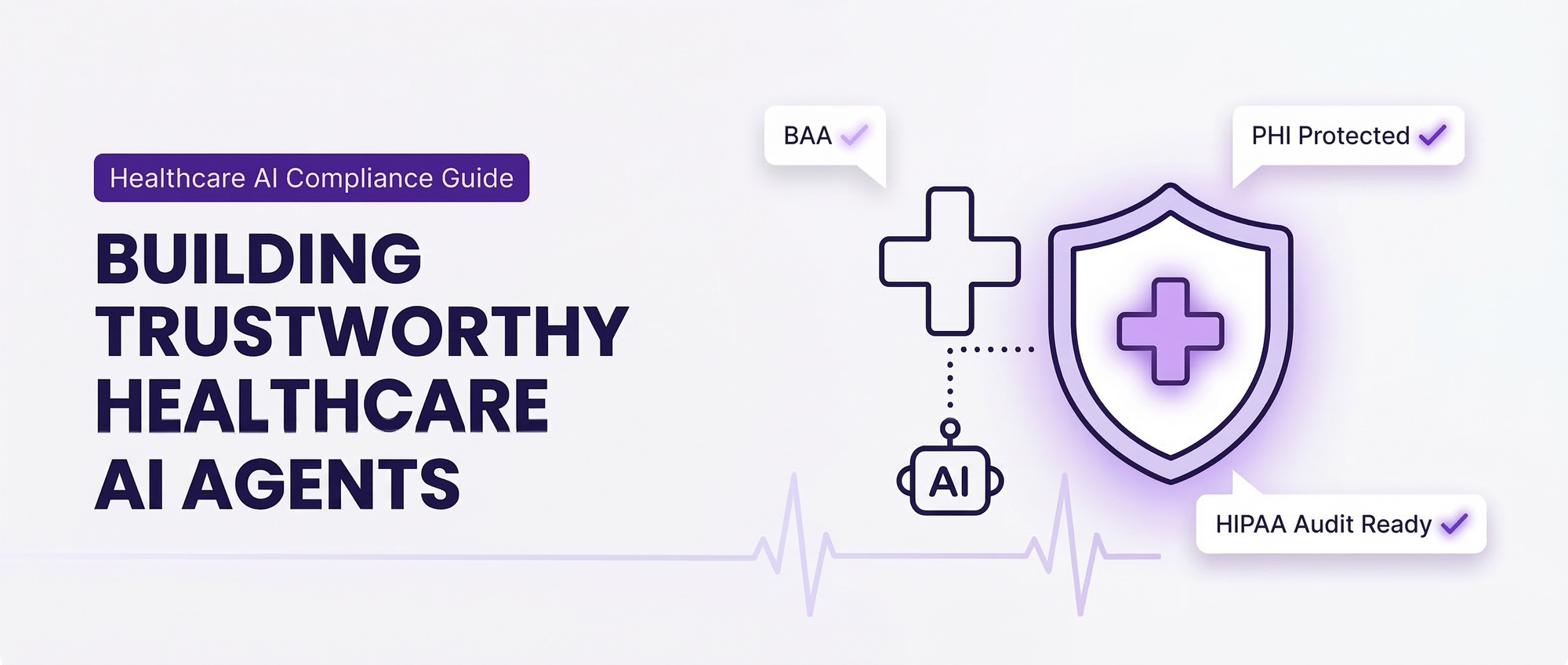
The Healthcare AI Agent Opportunity
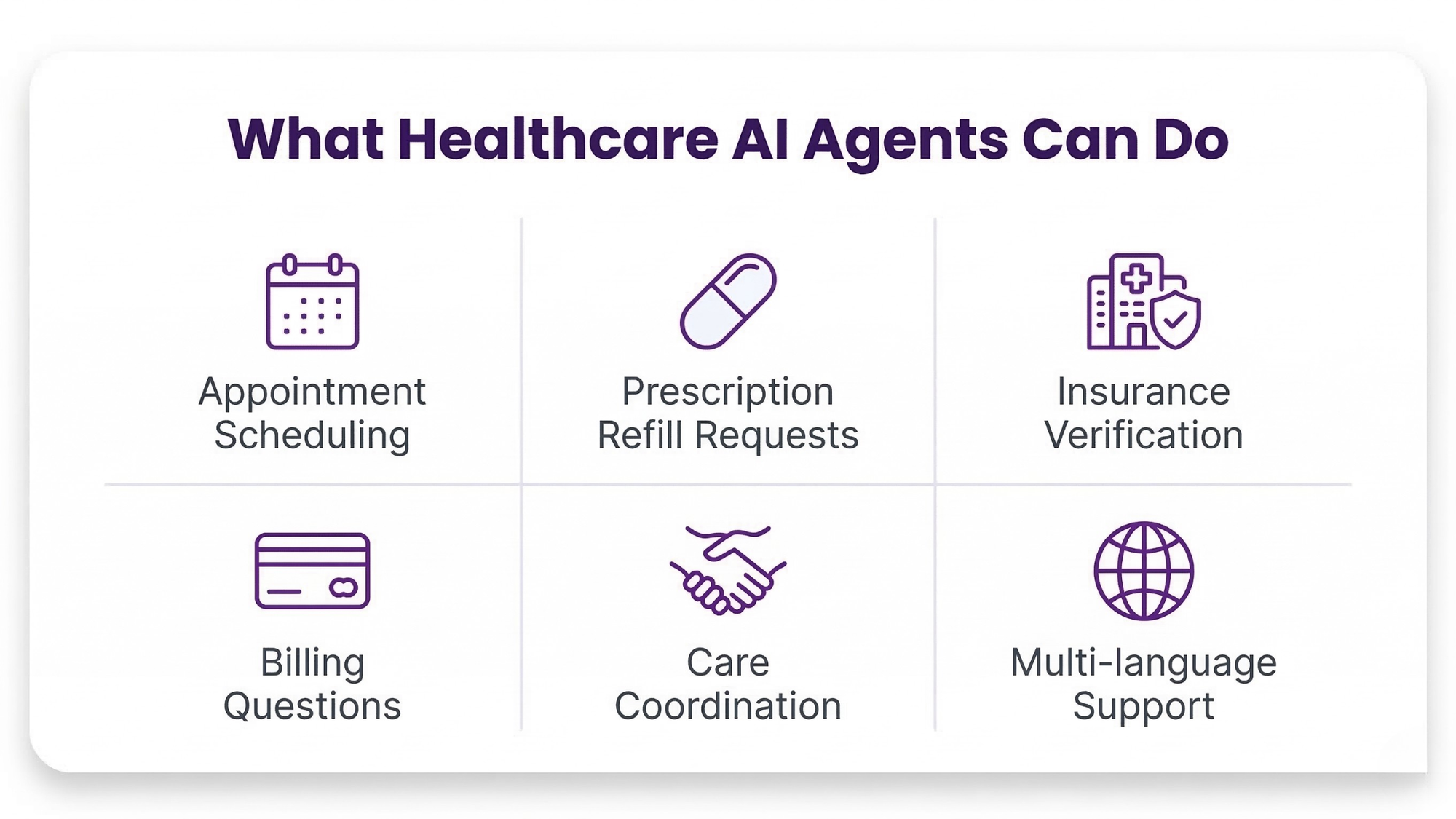
Healthcare organizations face enormous pressure to improve patient experience while managing costs. AI agents that can handle appointment scheduling, prescription refill requests, insurance verification, billing questions, and care coordination could transform healthcare operations. The potential is real, and OpenClaw's viral success proves that the underlying technology works.
But healthcare is not a typical industry. The regulatory framework surrounding patient data is among the most stringent in any sector, and the consequences of non-compliance are severe — both financially and in terms of patient trust.
What HIPAA Actually Requires for AI Agents
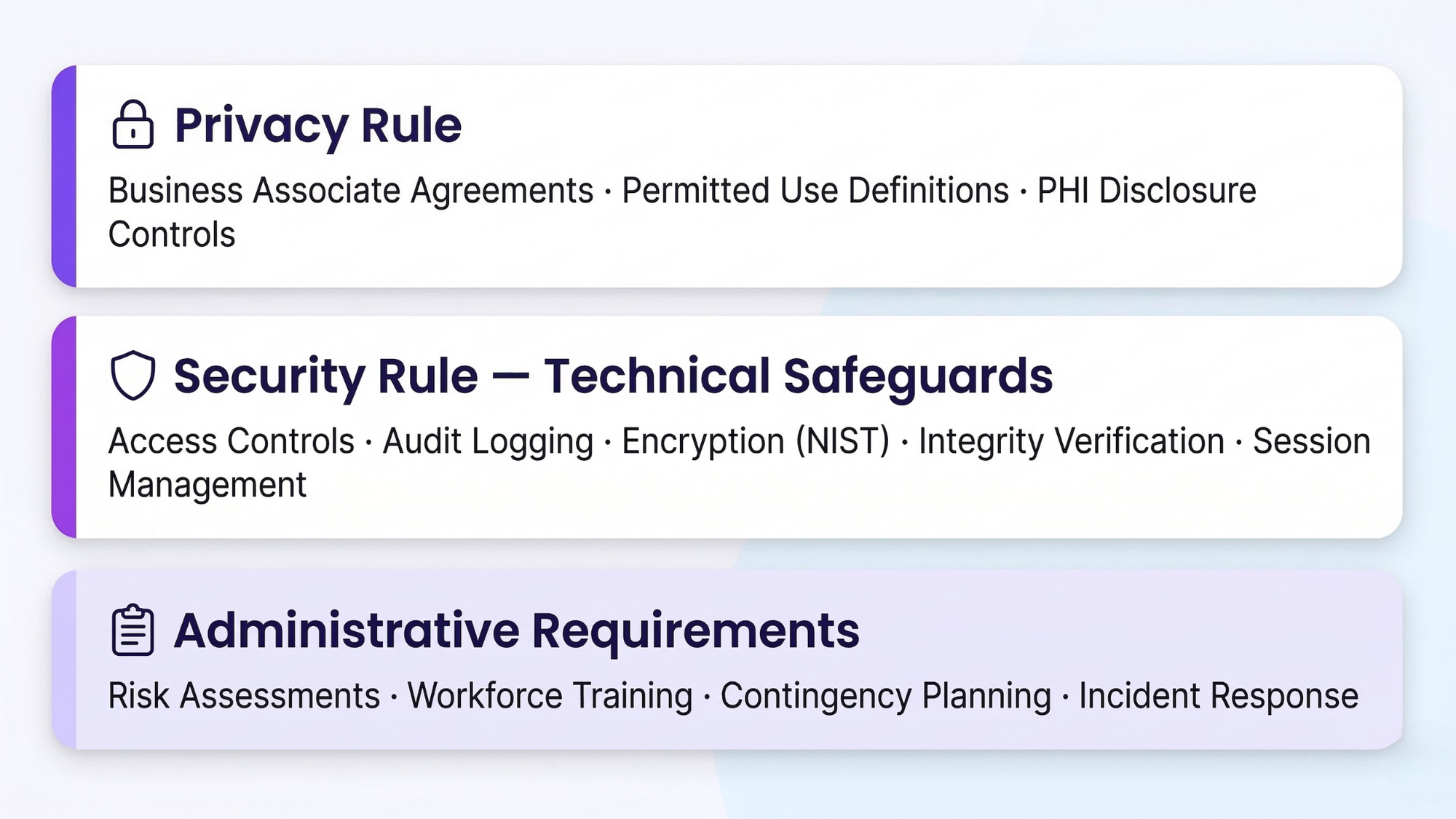
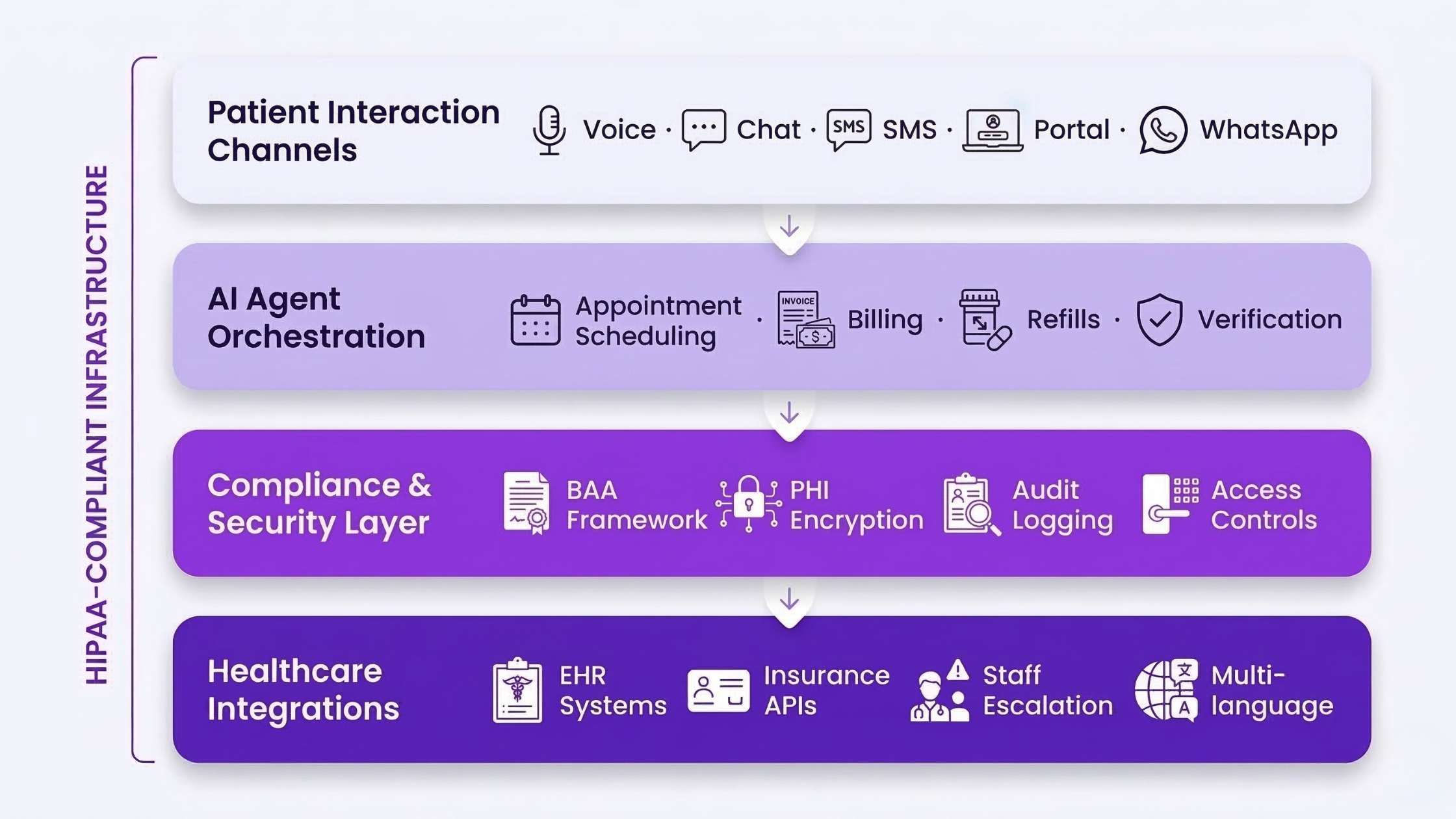
HIPAA's requirements for AI agents handling Protected Health Information are comprehensive and non-negotiable. The Privacy Rule requires that any system processing PHI does so under a valid Business Associate Agreement that defines permitted uses and disclosures. The Security Rule mandates technical safeguards including access controls, audit controls, integrity controls, and transmission security.
In practical terms, this means any AI agent handling patient communications must operate within infrastructure that provides documented access controls limiting who and what can reach PHI, comprehensive audit logging of every access to and action on PHI, encryption of PHI at rest and in transit meeting NIST standards, integrity verification ensuring PHI is not improperly altered, automatic session management and authentication controls, and incident detection and response procedures for potential PHI breaches.
Additionally, the organization deploying the AI agent must have a Business Associate Agreement with the platform provider, documented risk assessments covering the AI agent's data handling, workforce training on the AI agent's PHI handling procedures, and contingency plans for AI agent failures affecting patient care.
Where OpenClaw Falls Short
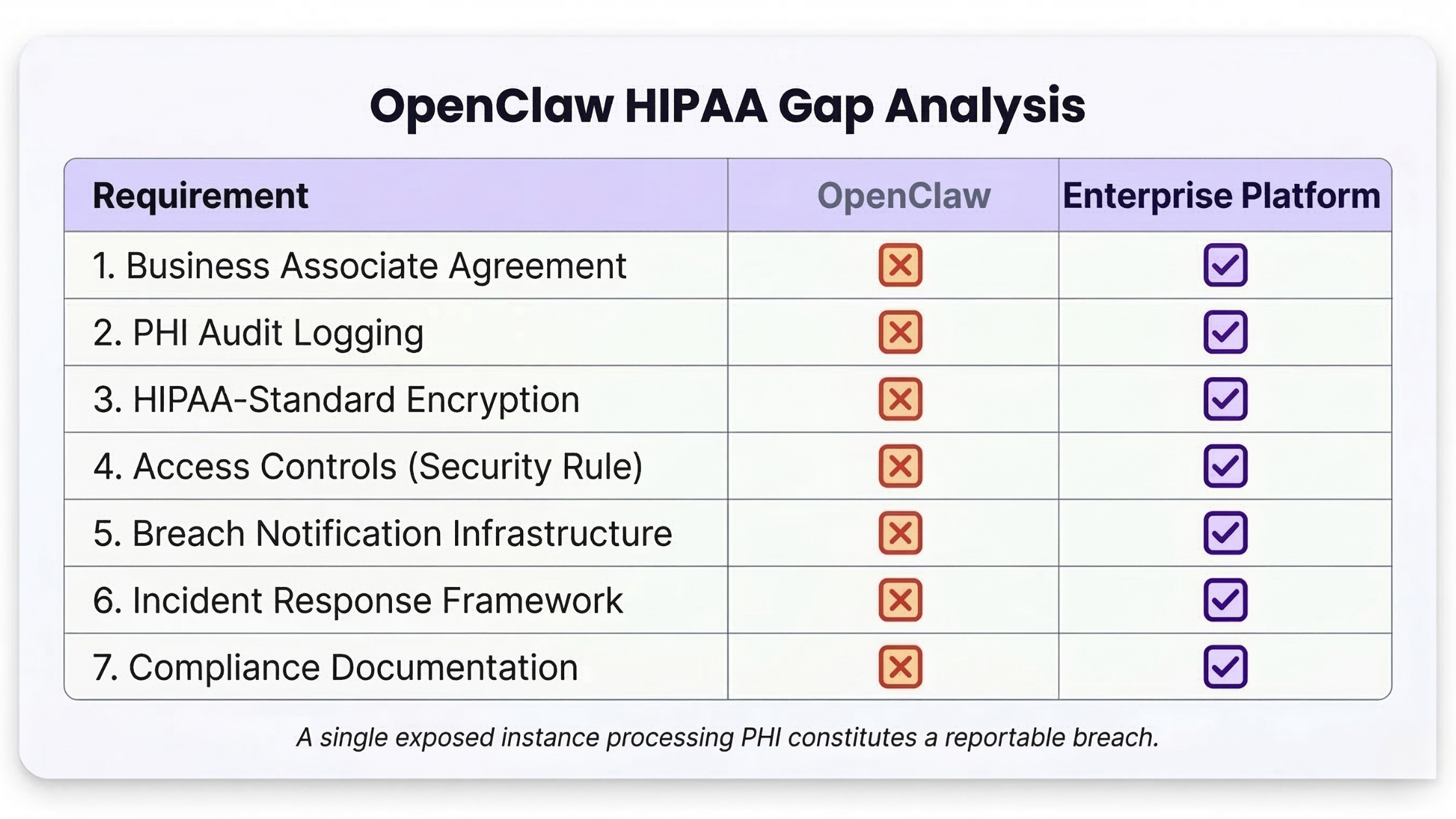
OpenClaw was not designed for regulated environments, and its architecture reflects that design intent. There is no entity to execute a Business Associate Agreement with — it is an open-source project, not a HIPAA-covered service provider. The audit logging required by the HIPAA Security Rule does not exist in a form that would satisfy auditors. Access controls are limited to whatever the host machine provides. PHI encryption depends entirely on the operator's implementation. There is no incident response framework, no breach notification infrastructure, and no compliance documentation.
Some healthcare IT teams might consider building HIPAA compliance on top of OpenClaw. While theoretically possible, this approach creates an ongoing maintenance burden that far exceeds the cost of a managed solution. Every OpenClaw update could break custom compliance controls. Every new skill or integration needs compliance review. The organization bears full liability for any gaps, with no vendor to share responsibility.
CrowdStrike and security researchers have already identified exposed OpenClaw instances on the public internet. In a healthcare context, a single exposed instance processing patient communications would constitute a reportable breach.
The Enterprise Alternative for Healthcare
Healthcare organizations that want the benefits of AI agents — and the benefits are substantial — need platforms built for regulated environments from the foundation. Enterprise AI agent platforms like Anyreach provide the infrastructure HIPAA demands: BAA-ready architecture, comprehensive audit trails, encryption meeting healthcare standards, access controls aligned with the Security Rule, and incident response capabilities.
Beyond compliance, healthcare-focused enterprise platforms offer capabilities that matter for patient experience: integration with EHR systems, appointment scheduling workflows, insurance verification automation, multi-language support for diverse patient populations, and warm handoff to human staff when clinical judgment is required.
The path forward for healthcare AI agents is clear. The technology is ready. Patient expectations are rising. But the path must go through compliant, purpose-built infrastructure — not through self-hosted personal AI agents that were never designed for regulated data.
Frequently Asked Questions
Is OpenClaw HIPAA compliant?
No. OpenClaw is an open-source personal AI agent that does not provide HIPAA compliance capabilities including Business Associate Agreements, audit logging for PHI access, HIPAA-standard encryption, or breach notification infrastructure.
Can you make OpenClaw HIPAA compliant?
While theoretically possible to build HIPAA compliance layers on top of OpenClaw, the ongoing maintenance burden, liability exposure, and lack of vendor support make this impractical. Healthcare organizations are better served by purpose-built enterprise AI agent platforms with documented HIPAA compliance.
What should healthcare organizations use instead of OpenClaw?
Healthcare organizations should use enterprise AI agent platforms that are designed for regulated environments, offering BAA-ready architecture, comprehensive audit trails, HIPAA-standard encryption, EHR integration, and professional support with documented compliance frameworks.
Ready for Enterprise-Grade AI Agents?
Anyreach delivers the agentic AI capabilities your organization needs with the security, compliance, and scalability enterprise operations demand. See how Anyreach can transform your customer and employee experience with AI agents that actually do things.
![[BPO Insights] Where We're Going: The Anyreach Vision for the Next 18 Months](https://storage.ghost.io/c/40/ac/40ac18d7-d0cb-4132-9e8b-e6740dedd4ad/content/images/size/w600/2026/02/05_the_2028_thesis-17.png)
![[BPO Insights] Mid-Year Performance Benchmarks in AI-Powered BPO Deployments](https://storage.ghost.io/c/40/ac/40ac18d7-d0cb-4132-9e8b-e6740dedd4ad/content/images/size/w600/2026/02/04_the_builders_log-17.png)
![[BPO Insights] Year 2 Revenue Scaling Patterns in the Small-to-Enterprise BPO Market](https://storage.ghost.io/c/40/ac/40ac18d7-d0cb-4132-9e8b-e6740dedd4ad/content/images/size/w600/2026/02/03_the_uncomfortable_math-17.png)
![[BPO Insights] The Warmest Introduction I've Ever Gotten Came From Our Smallest Customer](https://storage.ghost.io/c/40/ac/40ac18d7-d0cb-4132-9e8b-e6740dedd4ad/content/images/size/w600/2026/02/02_from_the_other_side-17.png)