
[OpenClaw] OpenClaw vs Building Your Own Enterprise AI Agent: A CTO's Guide
A CTO's comparison of using OpenClaw, building custom AI agents, or buying an enterprise platform. Evaluate build vs buy for enterprise AI agent deployment.

![[OpenClaw] OpenClaw vs Building Your Own Enterprise AI Agent: A CTO's Guide](https://storage.ghost.io/c/40/ac/40ac18d7-d0cb-4132-9e8b-e6740dedd4ad/content/images/size/w1200/2026/02/Anyreach-Openclaw-Blog-Cover--4--14.png)
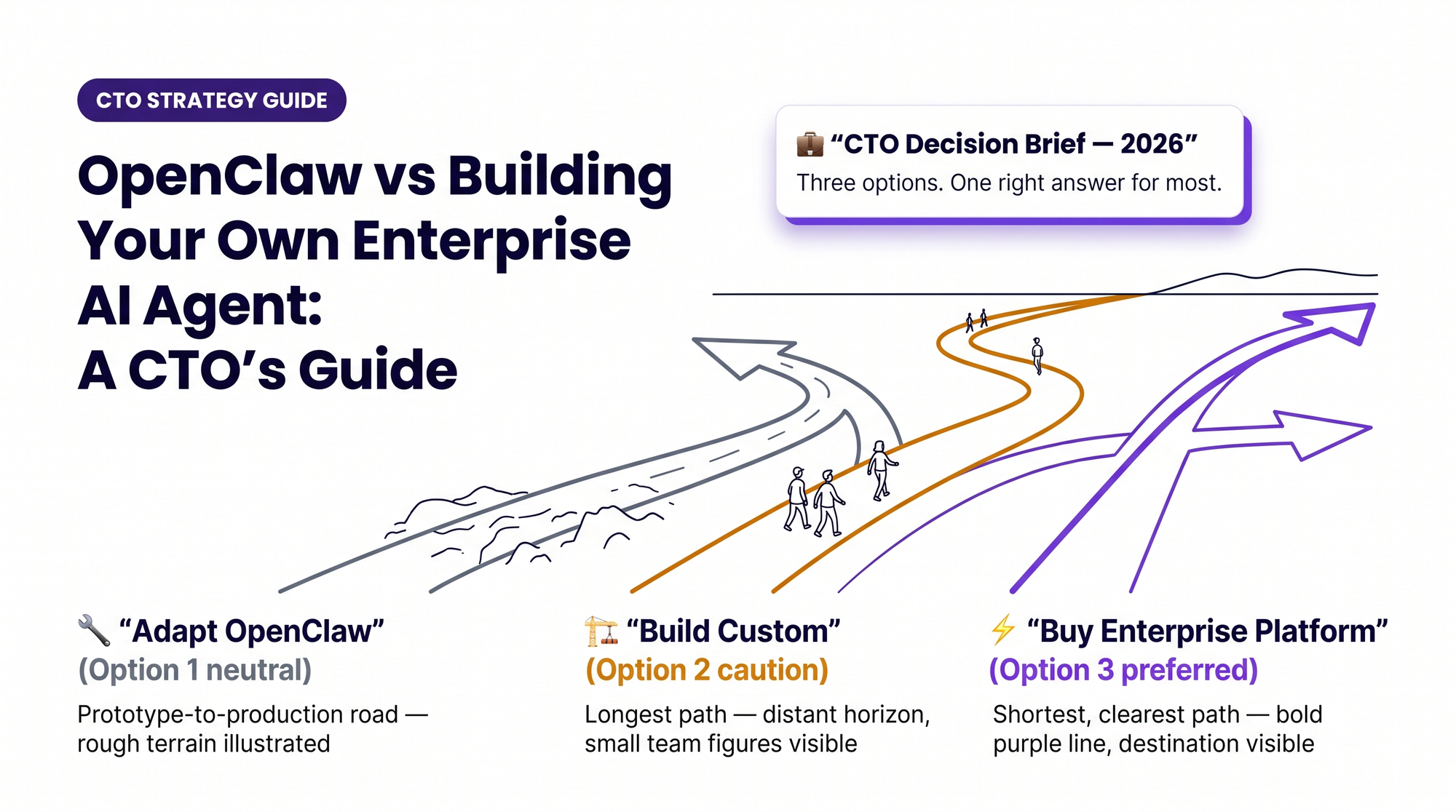
The Three Options Every CTO Is Evaluating
If you are a CTO in early 2026, the AI agent conversation is on your desk. Your CEO saw the OpenClaw headlines. Your VP of Operations wants to automate customer interactions. Your engineering team has already built prototypes. You need to make a decision about how your organization will deploy AI agents, and you have three fundamental options: adapt OpenClaw for enterprise use, build a custom platform, or buy an enterprise AI agent platform.
Each option has legitimate advantages and significant trade-offs. This guide walks through the evaluation framework that will help you make the right decision for your specific context.
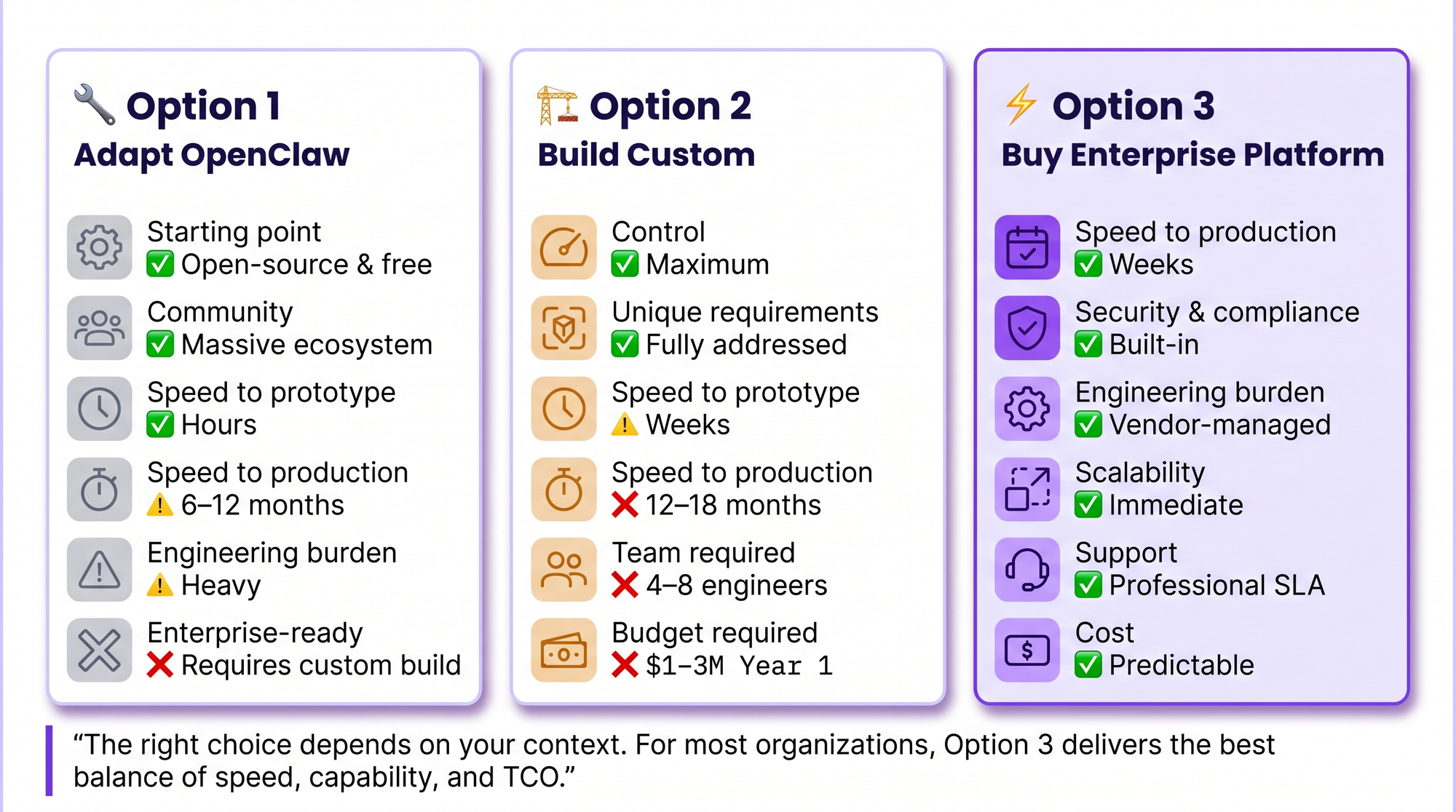
Option One: Adapt OpenClaw
OpenClaw's appeal for CTOs is obvious. It is open-source, highly extensible, and has a massive community building integrations and capabilities. Your engineering team can have a working prototype in hours.
The challenges emerge when you move toward production. Enterprise security hardening, compliance implementation, multi-tenant architecture, high availability infrastructure, monitoring and observability, and ongoing maintenance of custom modifications against a rapidly evolving open-source codebase all fall on your engineering team. You are essentially building an enterprise platform with OpenClaw as the starting point.
Realistic timeline: six to twelve months to production readiness, with one to two dedicated engineers for ongoing maintenance. Total first-year cost including engineering time, infrastructure, and LLM APIs often exceeds $500,000 for meaningful scale.
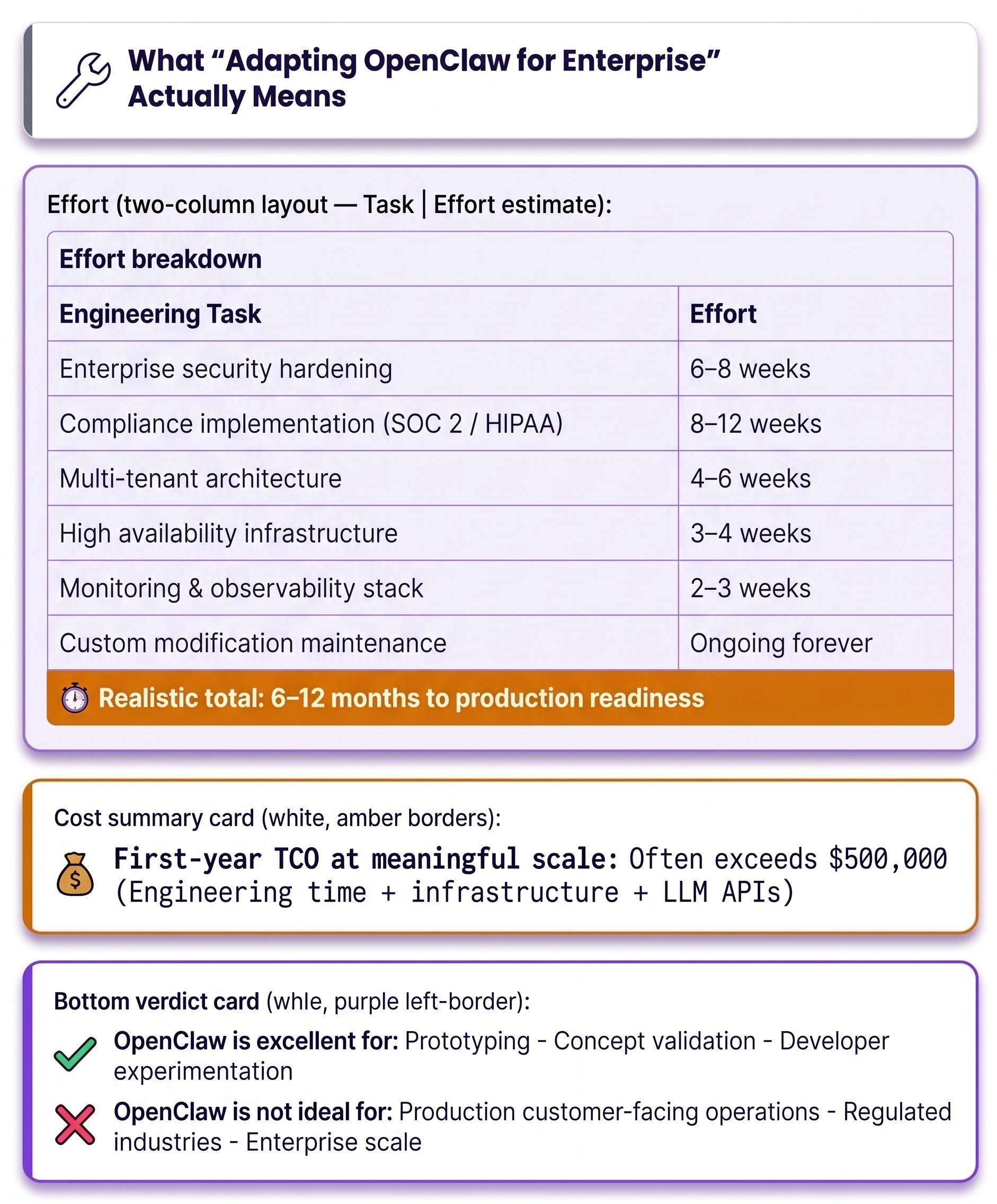
Option Two: Build Custom
Building from scratch gives you maximum control over architecture, security model, and feature set. For organizations with unique requirements or deep AI engineering talent, this can be the right choice.
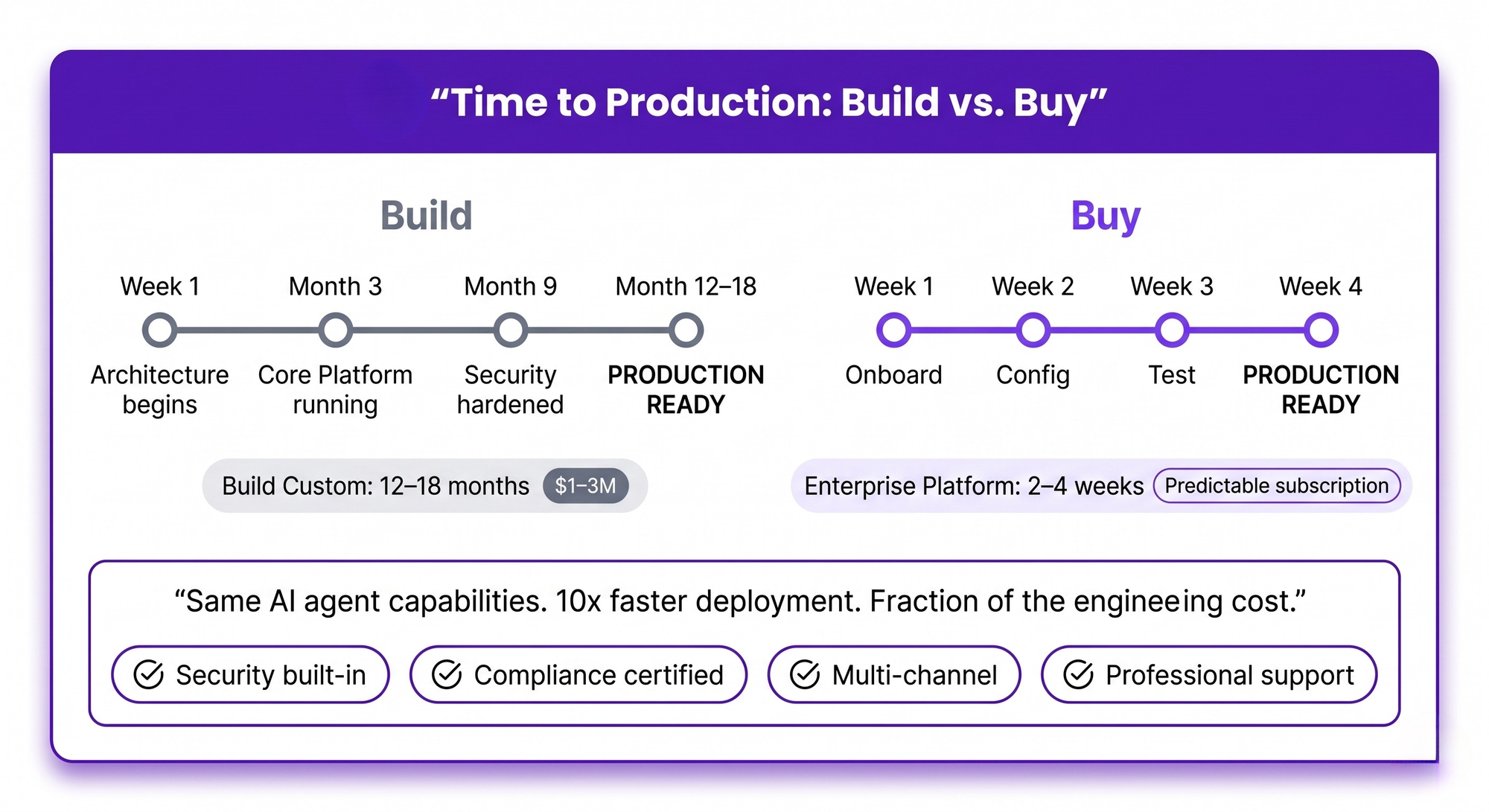
The trade-offs are significant. A production-grade AI agent platform requires expertise in LLM orchestration, conversation management, multi-channel integration, telephony, security engineering, and DevOps. The team size for a credible custom build is typically four to eight engineers, with a timeline of twelve to eighteen months to production readiness.
First-year costs including team, infrastructure, and tooling typically range from one to three million dollars. Ongoing costs remain substantial as the platform requires continuous development to keep pace with rapidly evolving AI capabilities.
Option Three: Buy an Enterprise Platform
Enterprise AI agent platforms like Anyreach provide production-ready AI agent deployment with security, compliance, and scalability built in. The primary advantage is time to value — organizations can deploy AI agents in weeks rather than months, with professional support for implementation and optimization.
The trade-offs include less customization flexibility compared to building from scratch, dependency on a vendor's roadmap and architecture decisions, and ongoing subscription costs. However, these costs are predictable and typically represent a fraction of the total cost of building and maintaining a custom platform.
For most organizations, the buy option delivers the best balance of speed, capability, cost, and risk. The platform vendor has already solved the production engineering challenges, security implementation, compliance certification, and multi-channel orchestration that would consume months of your engineering team's time.
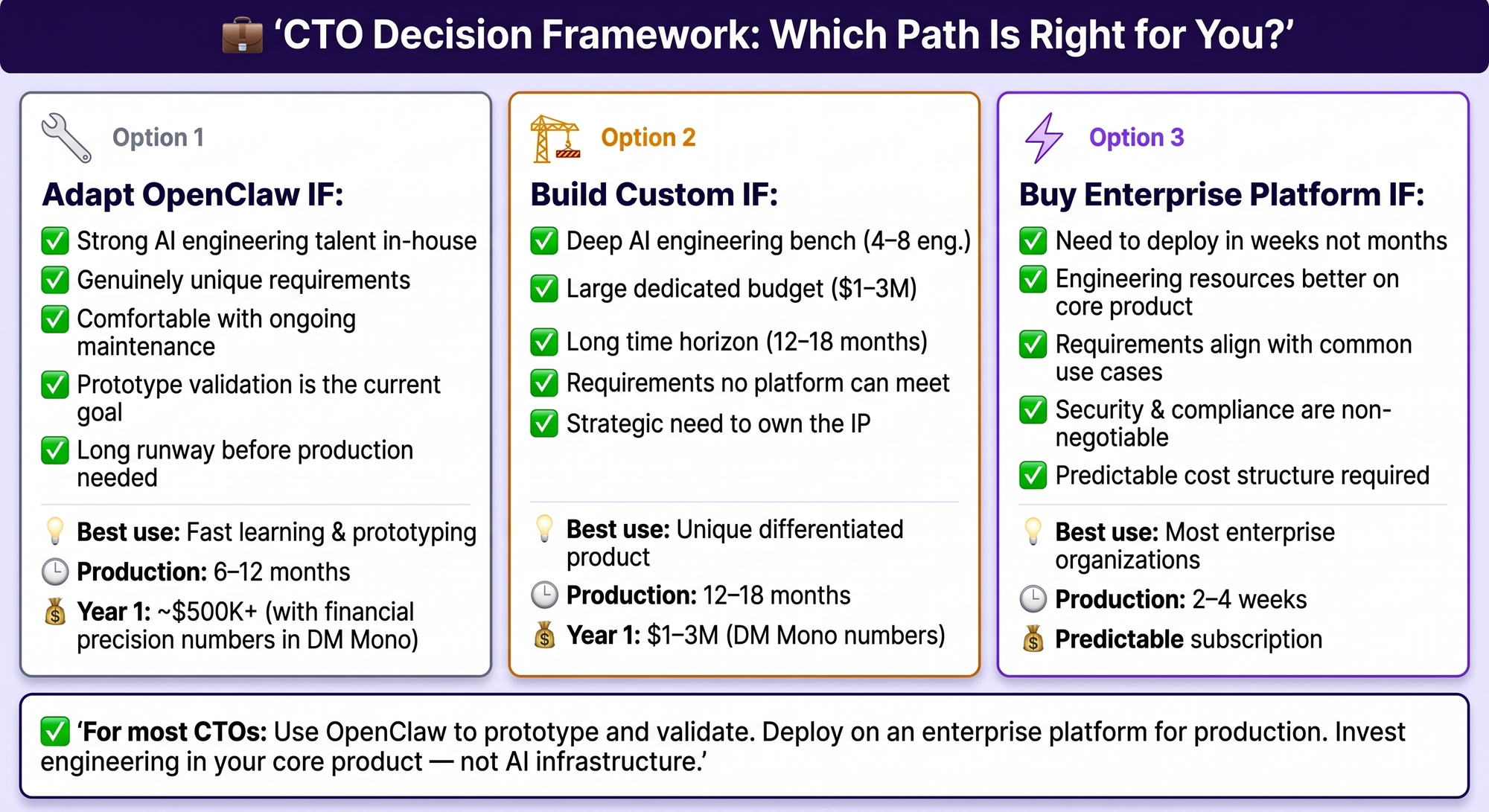
The Decision Framework
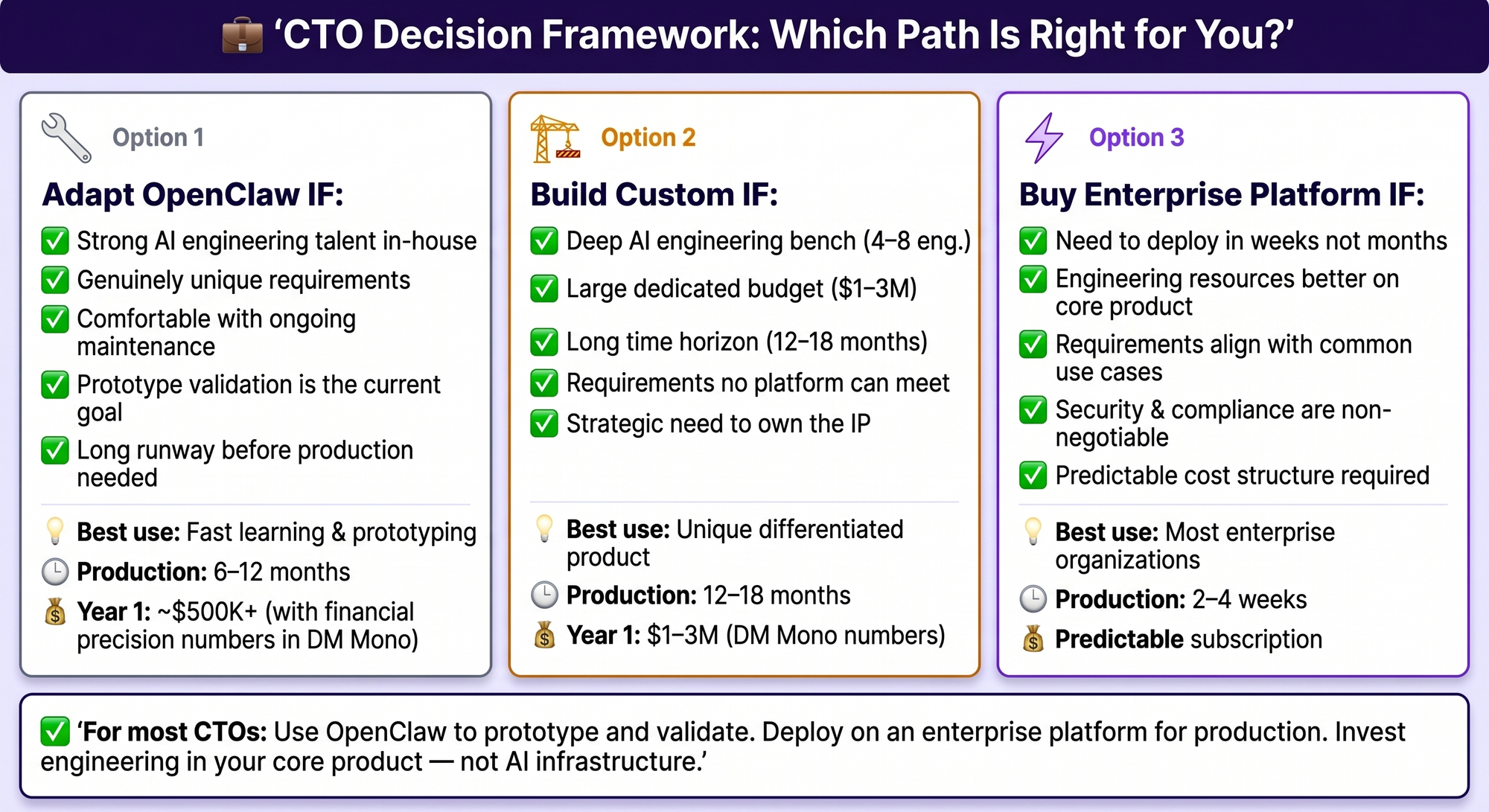
Choose OpenClaw adaptation if you have strong engineering talent with AI agent experience, your requirements are genuinely unique, and you are comfortable with the ongoing maintenance commitment. Choose custom build if you have deep AI engineering talent, a large budget, a long time horizon, and requirements that no existing platform can meet. Choose an enterprise platform if you need to deploy in weeks rather than months, your engineering resources are better spent on core product, and your requirements align with common enterprise AI agent use cases.
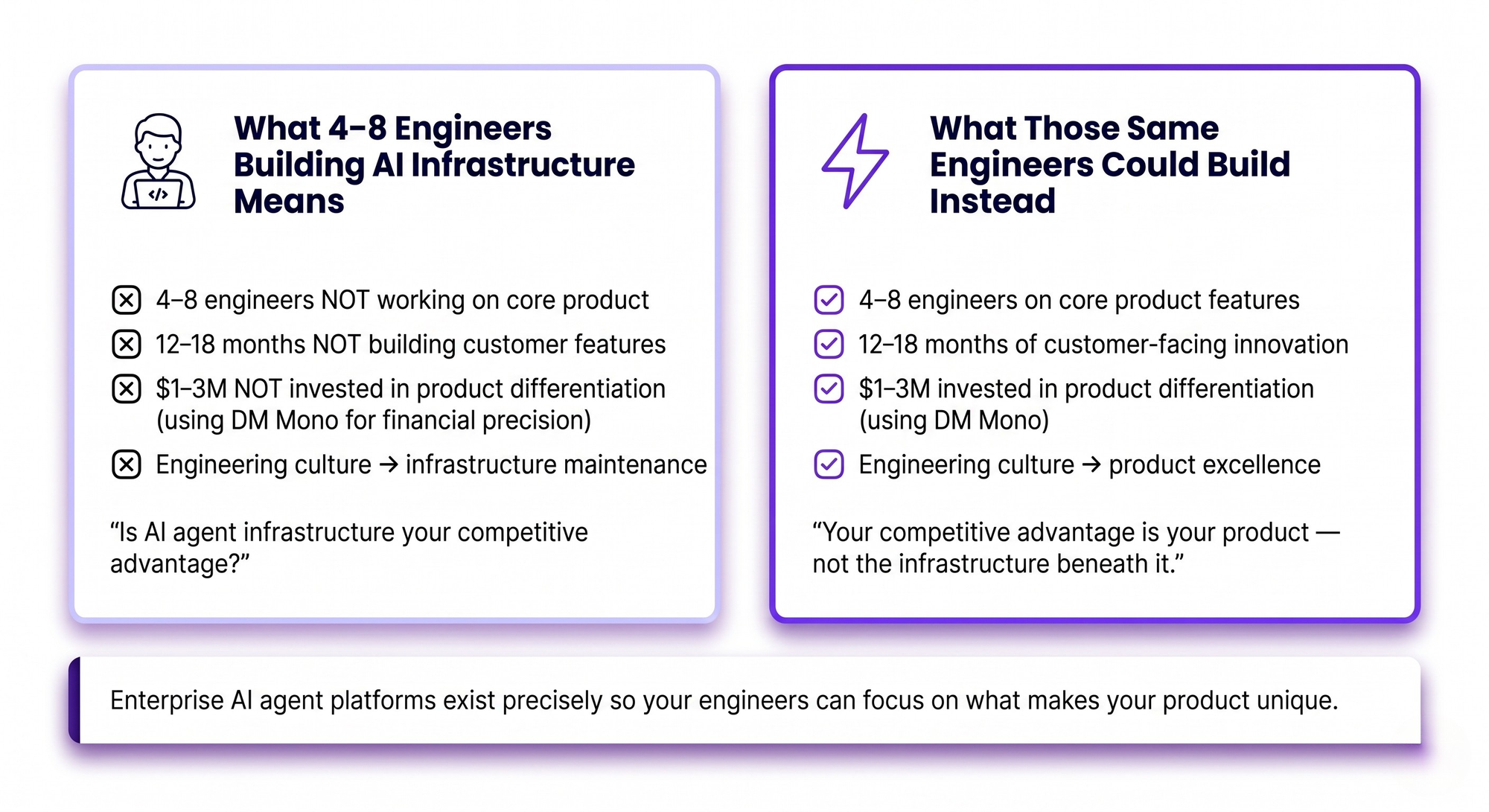
For most CTOs, the answer is clear. Use OpenClaw for prototyping and concept validation. Deploy on an enterprise platform for production. Invest your engineering resources in your core product, not in building and maintaining AI agent infrastructure.
Frequently Asked Questions
Should a CTO use OpenClaw or build a custom AI agent platform?
For most organizations, neither. OpenClaw is best for prototyping, and custom builds are only justified for truly unique requirements. Enterprise AI agent platforms provide the fastest, most cost-effective path to production deployment for common enterprise use cases.
How long does it take to make OpenClaw enterprise-ready?
Six to twelve months of engineering work for security hardening, compliance implementation, production infrastructure, and operational tooling, plus ongoing dedicated maintenance resources.
What is the total cost of building a custom AI agent platform?
First-year costs typically range from $1-3 million including a team of 4-8 engineers, infrastructure, tooling, and LLM API costs, with substantial ongoing costs for maintenance and development.
Ready for Enterprise-Grade AI Agents?
Anyreach delivers the agentic AI capabilities your organization needs with the security, compliance, and scalability enterprise operations demand. See how Anyreach can transform your customer and employee experience with AI agents that actually do things.
![[BPO Insights] Where We're Going: The Anyreach Vision for the Next 18 Months](https://storage.ghost.io/c/40/ac/40ac18d7-d0cb-4132-9e8b-e6740dedd4ad/content/images/size/w600/2026/02/05_the_2028_thesis-17.png)
![[BPO Insights] Mid-Year Performance Benchmarks in AI-Powered BPO Deployments](https://storage.ghost.io/c/40/ac/40ac18d7-d0cb-4132-9e8b-e6740dedd4ad/content/images/size/w600/2026/02/04_the_builders_log-17.png)
![[BPO Insights] Year 2 Revenue Scaling Patterns in the Small-to-Enterprise BPO Market](https://storage.ghost.io/c/40/ac/40ac18d7-d0cb-4132-9e8b-e6740dedd4ad/content/images/size/w600/2026/02/03_the_uncomfortable_math-17.png)
![[BPO Insights] The Warmest Introduction I've Ever Gotten Came From Our Smallest Customer](https://storage.ghost.io/c/40/ac/40ac18d7-d0cb-4132-9e8b-e6740dedd4ad/content/images/size/w600/2026/02/02_from_the_other_side-17.png)