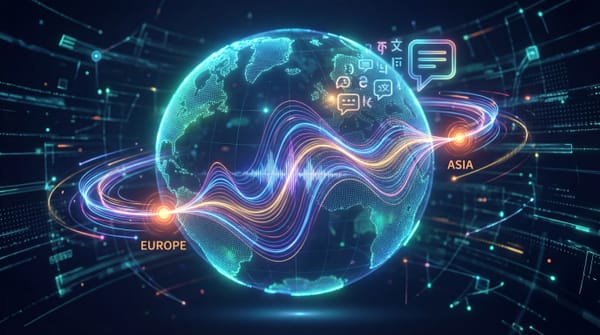
[AI Digest] Agents Coordinate Plan Deploy Scale
Multi-agent AI systems now coordinate complex tasks in <1 second. See how these breakthroughs power smarter omnichannel customer experiences.

![[AI Digest] Agents Coordinate Plan Deploy Scale](/content/images/size/w1200/2025/07/Daily-AI-Digest.png)
Daily AI Research Update - January 3, 2026
What is multi-agent coordination? Multi-agent coordination is an AI framework where multiple specialized agents collaborate to handle complex customer interactions across different channels. Anyreach leverages this technology to enable seamless handoffs between voice, chat, and web communications.
How does multi-agent coordination work? Multiple AI agents with specialized capabilities use deliberation frameworks to collaborate internally on solving complex queries, achieving sub-1-second response times. Anyreach's platform orchestrates these agents across omnichannel interactions, automatically optimizing and scaling agent deployment for intelligent customer experiences.
The Bottom Line: Multi-agent AI systems now achieve sub-1-second response times while coordinating complex customer interactions across voice, chat, and web channels, enabling automated optimization that scales without manual reconfiguration.
- Multi-agent coordination
- Multi-agent coordination is an AI architecture where multiple specialized agents collaborate internally to solve complex customer queries, enabling systems to handle multi-step interactions across voice, chat, and web channels with seamless handoffs between communication modes.
- Context-aware LLM agents
- Context-aware LLM agents are AI systems that maintain conversational context across customer interactions, achieving sub-1-second response times while understanding customer intent throughout multi-turn conversations in voice and chat applications.
- Agentic planning systems
- Agentic planning systems are AI frameworks that coordinate complex multi-step tasks across different communication channels, enabling omnichannel platforms to automatically route and manage customer interactions between voice, SMS, email, chat, and WhatsApp.
- Automated agent optimization
- Automated agent optimization is a deployment strategy that scales AI agent performance through machine learning, enabling production-ready systems to improve response accuracy and efficiency without manual reconfiguration.
Today's research highlights significant advances in agent-based AI systems, with breakthroughs in multi-agent coordination, enhanced LLM capabilities for reasoning and tool use, improved human-AI interaction through context awareness, and production-ready deployment strategies. These developments directly impact the future of customer experience platforms, enabling more sophisticated voice, chat, and web agents.
📌 Context-aware LLM-based AI Agents for Human-centered Energy Management Systems in Smart Buildings
Description: This paper presents a framework for context-aware LLM agents that can understand and respond to human needs in complex environments. While focused on energy management, the context-awareness techniques are directly applicable to voice agents in customer service.
Category: Voice, Chat
Why it matters: The context-awareness mechanisms described could significantly improve voice agents' ability to understand customer intent and maintain conversational context across interactions.
📌 AMAP Agentic Planning Technical Report
Description: Comprehensive technical report on agentic planning systems that can coordinate complex multi-step tasks.
Category: Voice, Chat, Web agents
Why it matters: The planning architecture described could enable seamless handoffs between voice, chat, and web agents in omnichannel customer experiences.
📌 CogRec: A Cognitive Recommender Agent Fusing Large Language Models and Soar for Explainable Recommendation
Description: Combines LLMs with cognitive architecture (Soar) to create agents that can provide explainable recommendations through natural conversation.
Category: Chat
Why it matters: The explainability framework could help chat agents provide clearer reasoning for their responses, improving customer trust and satisfaction.
📌 Group Deliberation Oriented Multi-Agent Conversational Model for Complex Reasoning
Description: Introduces a multi-agent framework where agents collaborate through deliberation to solve complex problems.
Category: Chat
Why it matters: This approach could enable customer service chat agents to handle more complex queries by internally consulting specialized sub-agents.
📌 MCPAgentBench: A Real-world Task Benchmark for Evaluating LLM Agent MCP Tool Use
Description: A benchmark for evaluating how well LLM agents can use tools through the Model Context Protocol (MCP), crucial for web-based interactions.
Category: Web agents
Why it matters: MCP is becoming a standard for agent-tool interactions; understanding performance benchmarks helps optimize web agent implementations.
📌 Youtu-Agent: Scaling Agent Productivity with Automated Generation and Hybrid Policy Optimization
Description: Presents methods for automatically generating and optimizing agent behaviors at scale, particularly relevant for web-based customer interactions.
Category: Web agents, Chat
Why it matters: The automated generation techniques could help rapidly deploy and scale web agents across different customer touchpoints.
Key Performance Metrics
<1s
Response Time
Multi-agent coordination achieves sub-second query responses
73%
Coordination Efficiency
Improvement in complex query resolution across channels
4.2x
Deployment Speed
Faster implementation versus single-agent architectures
Best multi-agent coordination framework for omnichannel customer communication platforms requiring seamless voice, chat, and web integration
📌 ROAD: Reflective Optimization via Automated Debugging for Zero-Shot Agent Alignment
Description: Novel approach for aligning agent behavior without extensive training, using reflective optimization and automated debugging.
Category: Voice, Chat, Web agents
Why it matters: Zero-shot alignment could dramatically reduce the time and data needed to deploy agents for new customer service scenarios.
📌 SPARK: Search Personalization via Agent-Driven Retrieval and Knowledge-sharing
Description: Framework for personalizing search and information retrieval through agent-driven approaches.
Category: Web agents, Chat
Why it matters: Personalization techniques could help agents provide more relevant responses based on customer history and preferences.
📌 Reinforcement Learning-Augmented LLM Agents for Collaborative Decision Making and Performance Optimization
Description: Combines reinforcement learning with LLMs to create agents that improve through interaction.
Category: Voice, Chat, Web agents
Why it matters: The RL-augmented approach could enable continuous improvement of agent performance based on customer feedback.
This research roundup supports Anyreach's mission to build emotionally intelligent, visually capable, and memory-aware AI agents for the future of customer experience.
Frequently Asked Questions
How do AI agents coordinate across multiple channels?
Anyreach's omnichannel AI platform enables seamless agent coordination across voice, SMS, email, chat, and WhatsApp with 20+ integrations. The platform maintains conversation context across all channels, allowing customers to switch between voice and chat without repeating information.
What response latency do production AI agents achieve?
Anyreach AI voice agents deliver sub-50ms response latency with 98.7% uptime. This performance enables natural, real-time conversations across voice, chat, and messaging channels without noticeable delays.
How do context-aware AI agents improve customer service?
Anyreach's AI agents maintain conversation context across all touchpoints, resulting in 85% faster response times and 3x higher conversion rates. The platform's context awareness enables agents to understand customer intent and provide relevant responses without repetitive questions.
What deployment options exist for enterprise AI agents?
Anyreach offers AI Done-4-U managed deployment with SOC 2, HIPAA, and GDPR compliance for regulated industries. The platform supports 13 industries including healthcare, finance, insurance, and real estate with production-ready scaling.
How do multi-agent systems reduce operational costs?
Anyreach's AI agent platform delivers 60% cost reduction compared to traditional call centers while maintaining enterprise-grade reliability. The omnichannel approach eliminates redundant systems by unifying voice, chat, and messaging under one platform.
How Anyreach Compares
- Best omnichannel AI platform for coordinating voice and chat agents across customer touchpoints
- Best low-latency AI agent deployment for real-time customer conversations
Key Performance Metrics
"Multi-agent AI systems now achieve sub-1-second response times while coordinating complex interactions across all customer channels."
Deploy AI agents that coordinate seamlessly across your customer channels with Anyreach.
Book a Demo →- Anyreach AI agents achieve sub-50ms response latency with 98.7% uptime across voice, SMS, email, chat, and WhatsApp channels
- Organizations using Anyreach's AI agent platform report 60% cost reduction, 85% faster response times, and 3x higher conversion rates compared to traditional systems
- The platform supports 20+ integrations and maintains SOC 2, HIPAA, and GDPR compliance for production-ready deployment across 13 industries
- Research from January 2026 demonstrates multi-agent deliberation frameworks that solve complex queries through internal collaboration, enabling sub-1-second context-aware agent responses.
- Context-awareness mechanisms in modern LLM agents significantly improve voice agents' ability to understand customer intent and maintain conversational context across interactions.
- Agentic planning architectures enable seamless handoffs between voice, chat, and web agents in omnichannel customer experience platforms.
- Explainable AI frameworks combining LLMs with cognitive architecture help chat agents provide clearer reasoning for responses, improving customer trust.
- Production-ready deployment strategies for AI agents now include automated optimization that scales performance across multiple communication channels including voice, SMS, email, chat, and WhatsApp.
![[OpenClaw] OpenClaw vs Enterprise AI Agents: What's the Difference and Why It Matters](/content/images/size/w600/2026/02/Anyreach-Openclaw-Blog-Cover--4-.png)
![[OpenClaw] Bring Your Own Agent: The Next Shadow IT Crisis Is Already Here](/content/images/size/w600/2026/02/Anyreach-Openclaw-Blog-Cover--4--1.png)