
[OpenClaw] Bring Your Own Agent: The Next Shadow IT Crisis Is Already Here
Employees are adopting personal AI agents like OpenClaw for work tasks. Learn why BYOA is the next shadow IT crisis and how enterprises can respond strategically.

![[OpenClaw] Bring Your Own Agent: The Next Shadow IT Crisis Is Already Here](/content/images/size/w1200/2026/02/Anyreach-Openclaw-Blog-Cover--4--1.png)
The Pattern We Have Seen Before
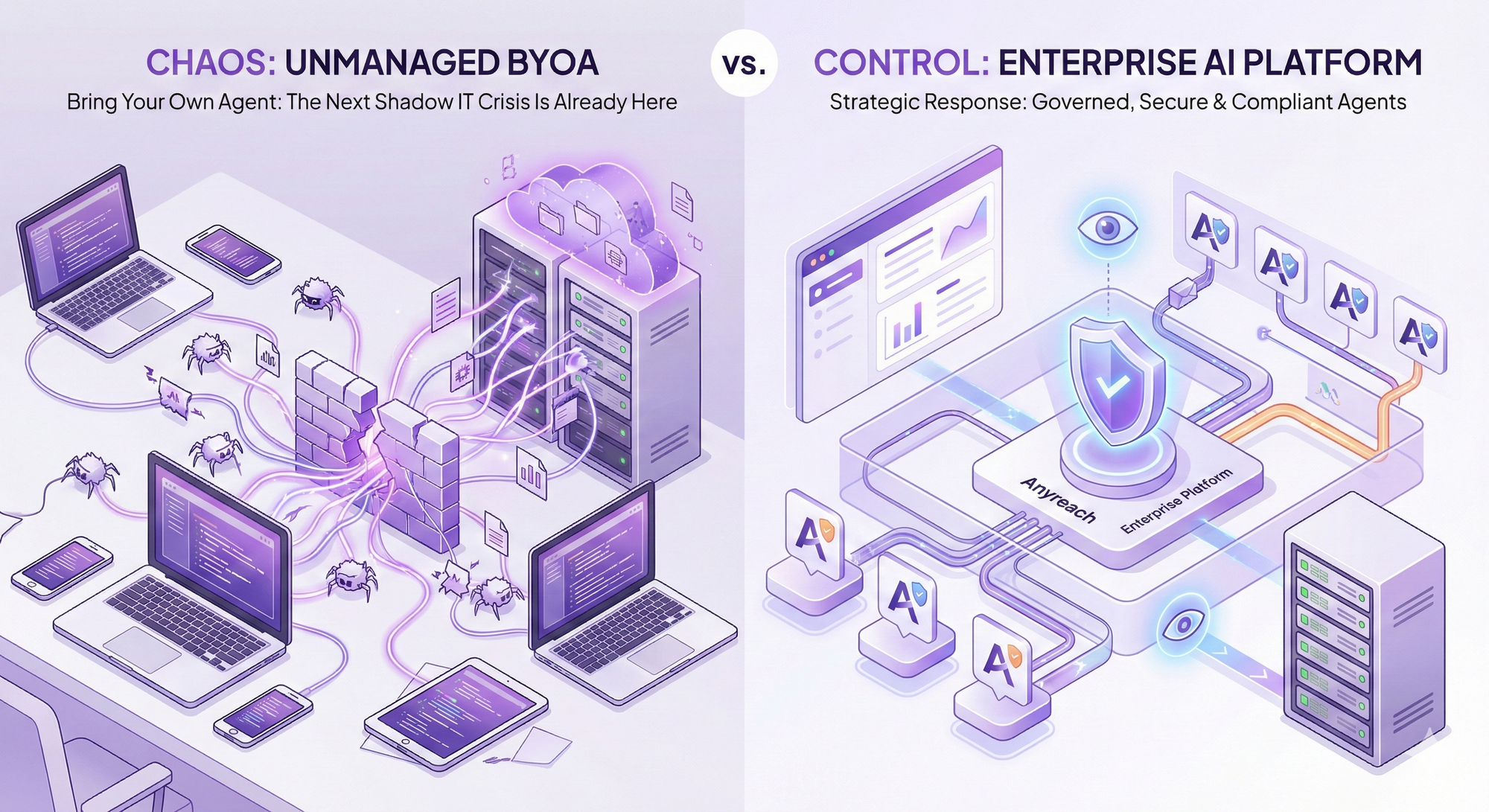
Every few years, a consumer technology becomes so useful that employees start bringing it to work before IT departments can react. It happened with personal smartphones. It happened with Dropbox. It happened with ChatGPT. And now, it is happening with personal AI agents.
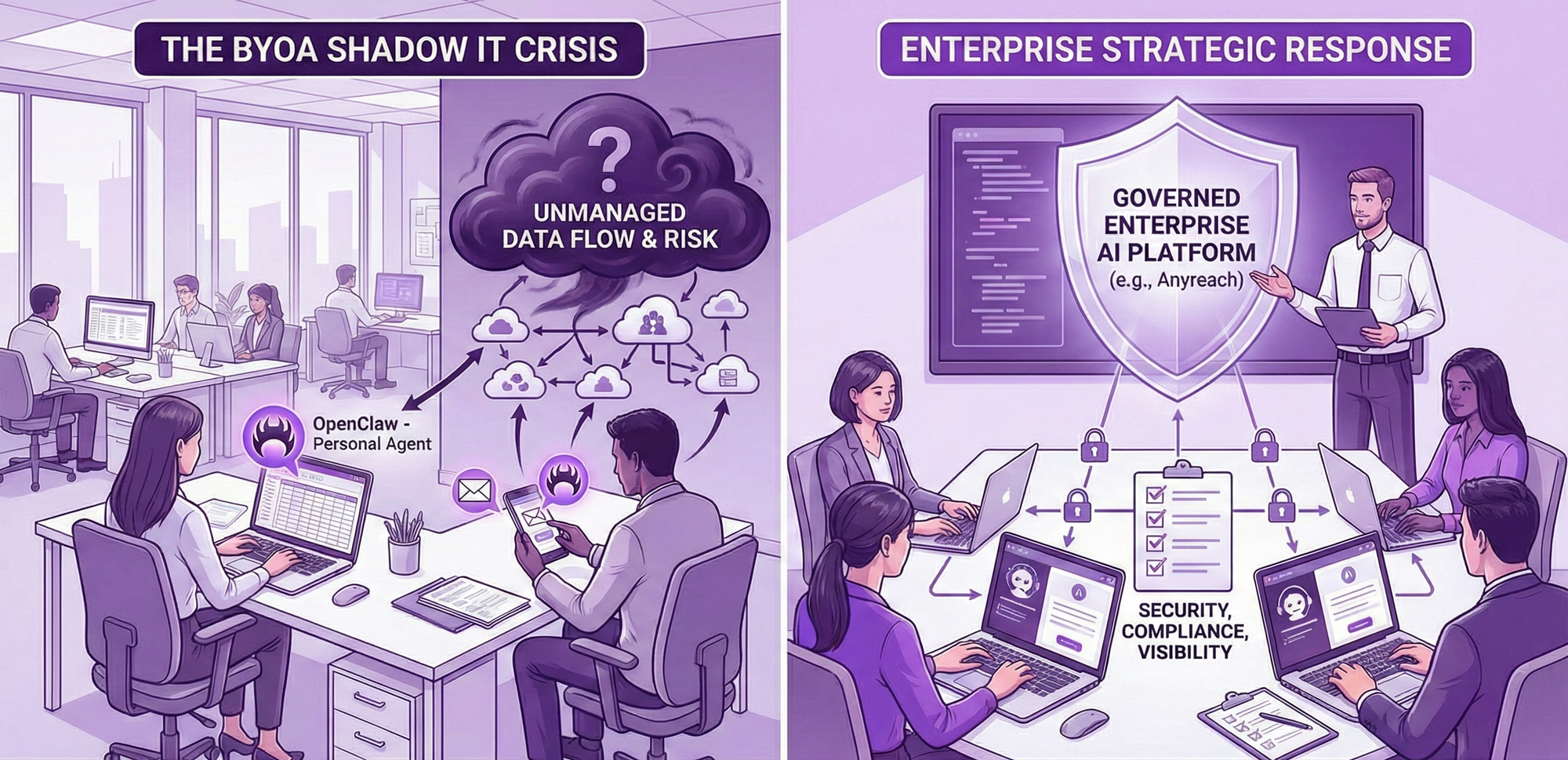
OpenClaw, the open-source autonomous AI agent platform that exploded to over 180,000 GitHub stars in early 2026, represents a fundamentally new category of shadow IT. Unlike previous waves, this one does not just store or process data. It acts. It sends emails, manages calendars, browses the web, runs scripts, and operates continuously in the background. When employees connect these agents to work tools, they create a shadow workforce that IT has zero visibility into.
This is not a hypothetical scenario. It is happening right now in enterprises everywhere.
Why BYOA Is Different from Previous Shadow IT Waves
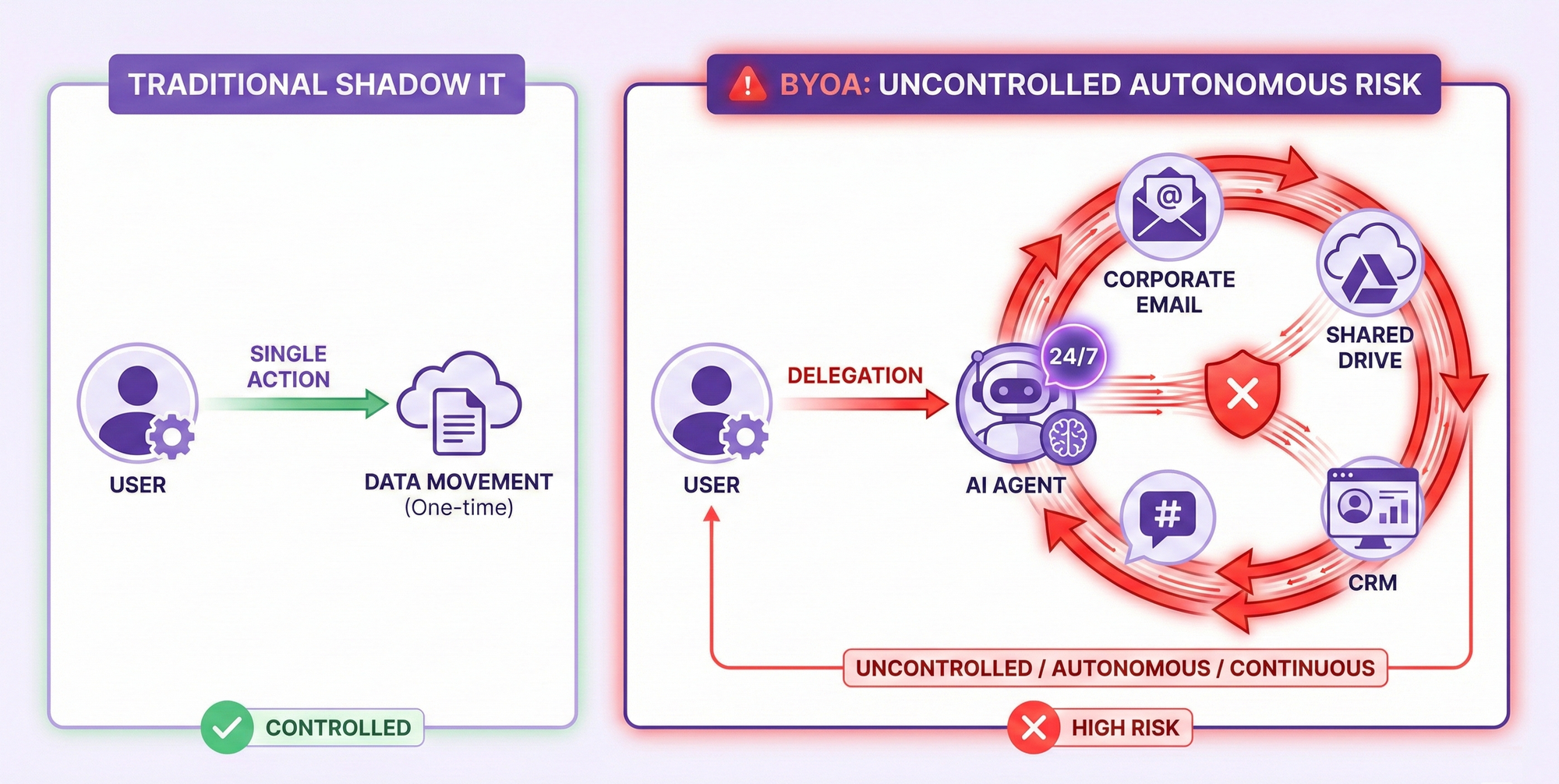
When employees started using personal Dropbox accounts for work, the risk was data leakage. When they started pasting sensitive information into ChatGPT, the risk was data exposure. Both were serious, but both were fundamentally passive. The user took a deliberate action each time data left the corporate perimeter.
Personal AI agents change the equation entirely. An OpenClaw instance running on an employee's Mac Mini at home can be connected to their work Slack, corporate email, shared Google Drive, and project management tools. Once connected, the agent operates continuously and autonomously. It might summarize internal emails and store them locally. It might respond to Slack messages based on confidential context. It might access customer data to complete a task the employee delegated to it last Tuesday and forgot about.
The critical difference is persistence and autonomy. A personal AI agent does not require the employee to make a conscious decision each time data crosses a boundary. The agent simply does what it was configured to do, around the clock, with whatever access it has been granted.
The Real Risks Enterprises Face
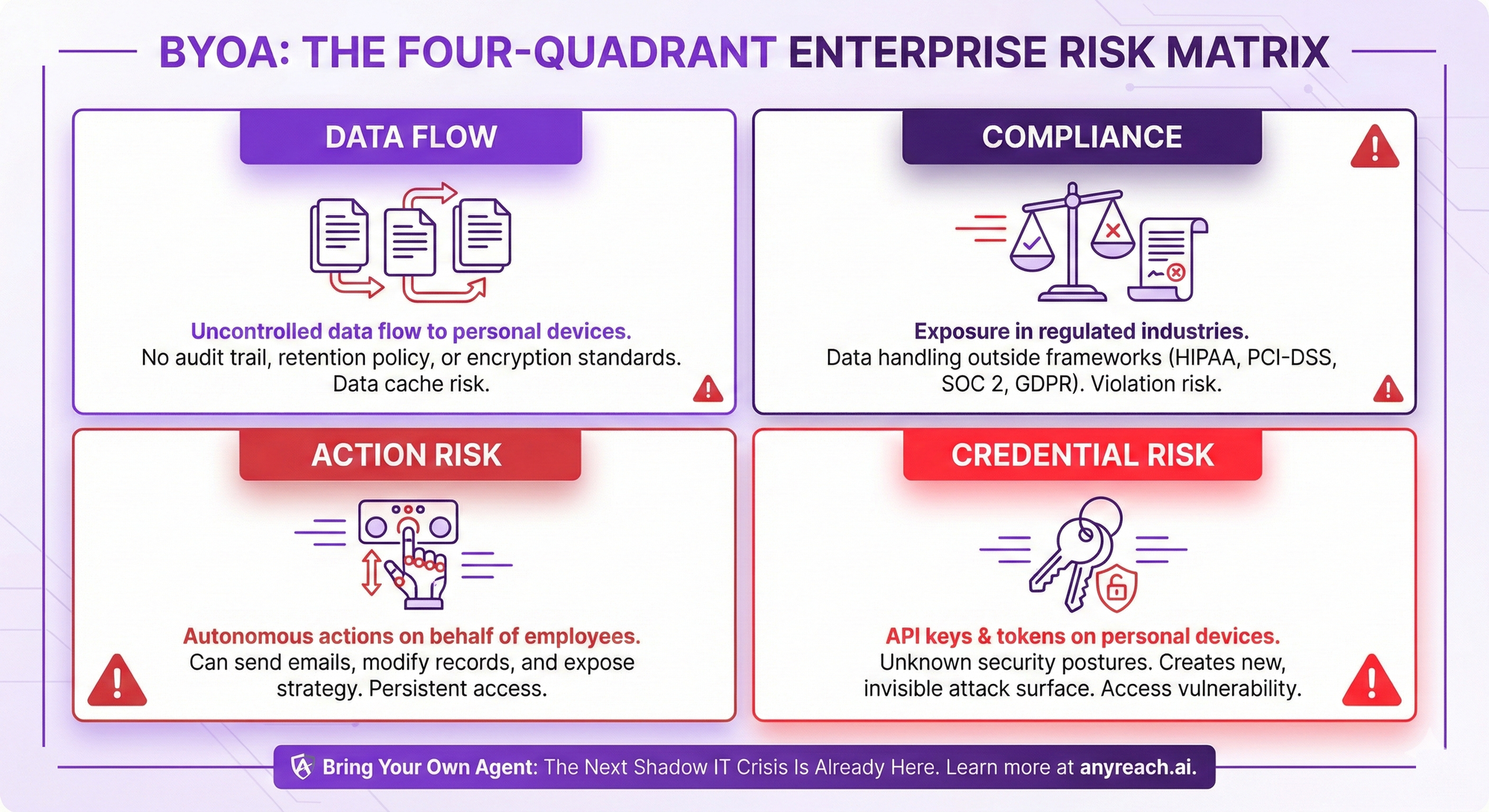
The security implications extend far beyond traditional data loss prevention. First, there is the issue of uncontrolled data flow. Corporate data flowing to personal infrastructure has no audit trail, no retention policy, and no encryption standards. A personal AI agent might cache months of internal communications on an unmanaged device.
Second, there is the compliance exposure. In regulated industries like healthcare and financial services, data handled by personal AI agents falls outside every compliance framework the organization has built. HIPAA, PCI-DSS, SOC 2, GDPR — none of these contemplate an employee's personal AI assistant processing protected data on consumer hardware.
Third, there is the action risk. Unlike previous shadow IT, personal AI agents can take actions on behalf of employees. An agent with access to email could send a response containing sensitive information. An agent with calendar access could accept meetings or share availability in ways that expose organizational strategy. An agent with access to a CRM could modify customer records.
Finally, there is the credential and access risk. Personal AI agents require API keys, OAuth tokens, and other credentials to connect to enterprise systems. These credentials live on personal devices with unknown security postures, creating a new and largely invisible attack surface.
Why Banning Will Not Work
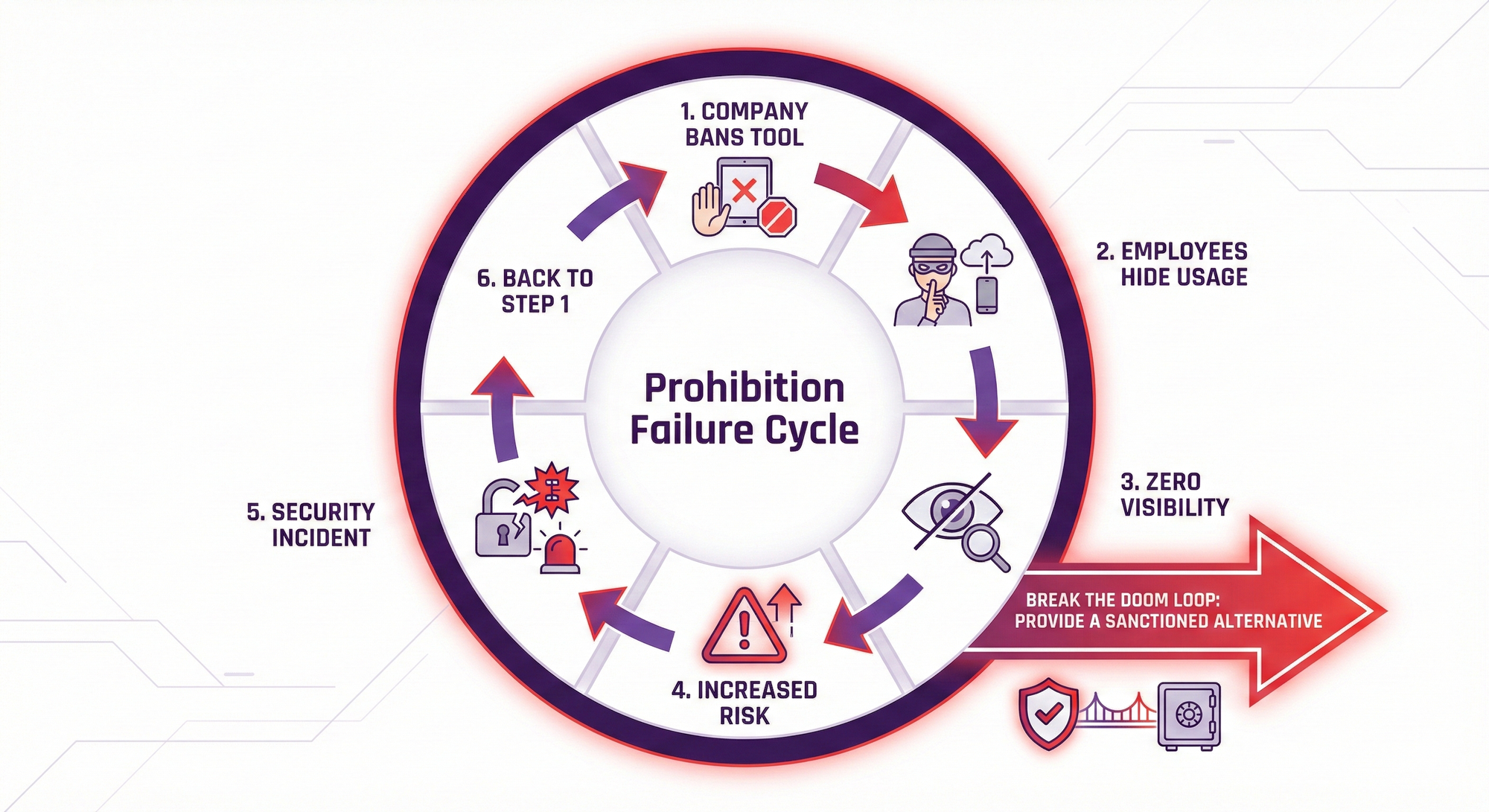
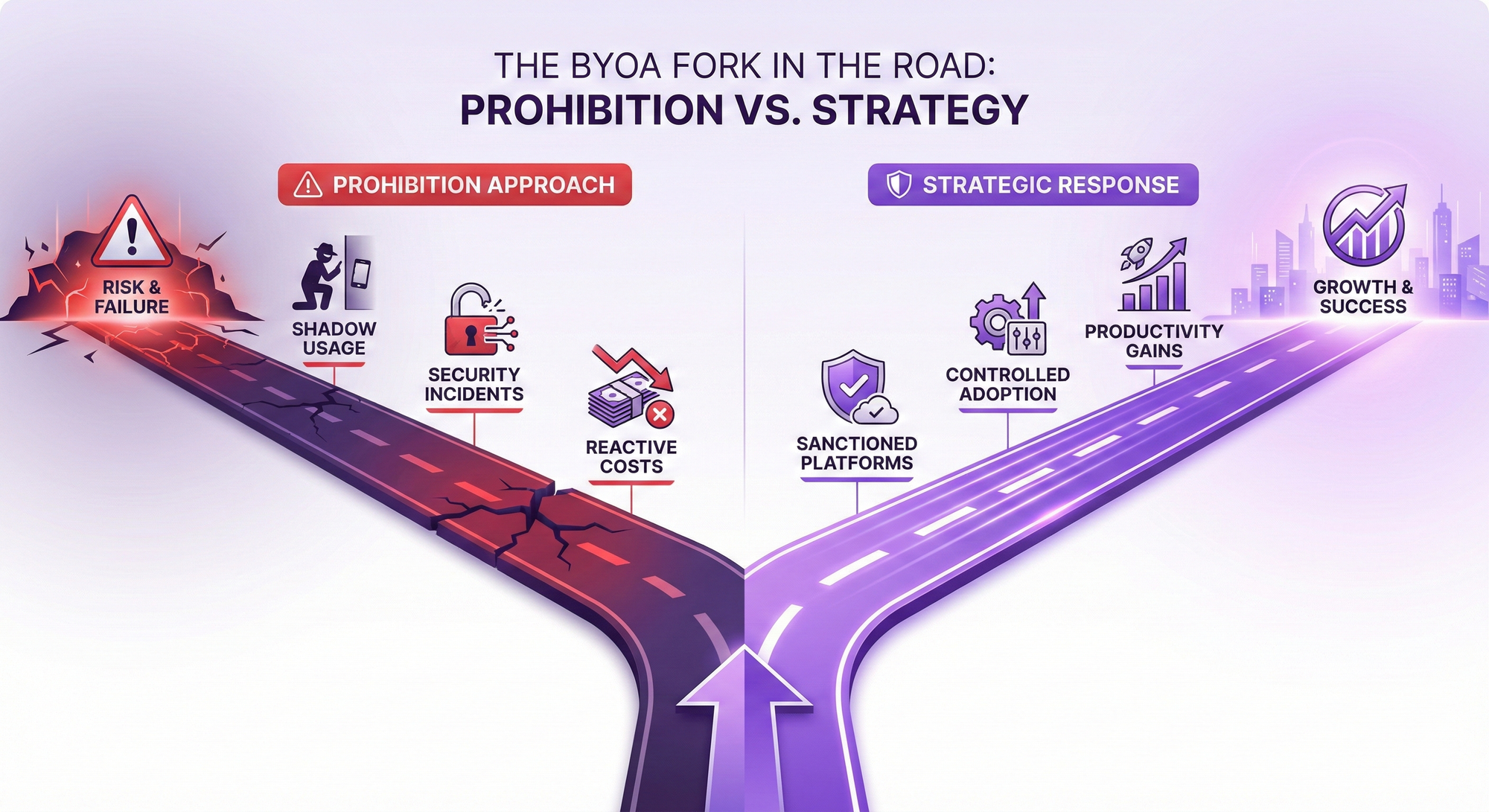
History tells us that prohibition is not an effective strategy for shadow IT. Enterprises that banned personal smartphones saw employees simply hide their usage. Organizations that blocked Dropbox watched employees switch to dozens of alternative file-sharing services. Companies that prohibited ChatGPT found employees accessing it through VPNs and personal devices.
The same dynamic will play out with personal AI agents, only faster. The productivity gains from having a personal AI assistant are too significant for knowledge workers to willingly give up. An employee who has automated two hours of daily busywork through OpenClaw is not going to stop because IT sent a policy memo.
Moreover, the nature of personal AI agents makes them nearly impossible to detect through traditional means. The agent runs on personal hardware, communicates through encrypted messaging platforms, and accesses corporate systems using the employee's legitimate credentials. From the enterprise's perspective, the traffic looks identical to the employee working normally.
The Strategic Response: Channel the Demand
The enterprises that handled previous shadow IT waves most effectively were those that recognized the underlying demand and provided a sanctioned alternative. Salesforce emerged as the answer to sales teams building their own customer databases. Slack became the sanctioned alternative to employees using WhatsApp for work. Box and OneDrive replaced unauthorized Dropbox usage.
The same playbook applies to personal AI agents. Rather than fighting the inevitable adoption of AI assistants, forward-thinking enterprises are deploying managed AI agent platforms that satisfy the same demand while maintaining security, compliance, and governance.
This means providing employees and customer-facing teams with AI agents that can genuinely act across communication channels — voice, chat, email, SMS, and messaging platforms — with enterprise-grade security controls, audit trails, and compliance frameworks built in from the foundation. Platforms like Anyreach are purpose-built for exactly this scenario, offering the autonomous, action-taking AI agent experience that employees are seeking through OpenClaw, but with the governance and control that enterprises require.
The window for proactive response is narrow. Organizations that wait until personal AI agents create a security incident will find themselves in a reactive, costly, and disruptive cleanup. Those that act now to provide sanctioned AI agent capabilities will not only mitigate the risk but capture the productivity gains that are driving adoption in the first place.
Frequently Asked Questions
What is Bring Your Own Agent (BYOA)?
BYOA refers to employees using personal AI agent platforms like OpenClaw for work tasks without IT department approval or oversight. Unlike traditional shadow IT, these agents operate autonomously, have persistent system access, and can take actions on behalf of employees around the clock.
Why is BYOA more dangerous than previous shadow IT?
Personal AI agents combine data access with autonomous action-taking. They run 24/7, can send emails, modify records, and process data continuously without requiring the employee to make a conscious decision each time. This creates uncontrolled data flows, compliance gaps, and action risks that traditional shadow IT did not present.
How should enterprises respond to BYOA?
The most effective response is to provide a sanctioned enterprise AI agent platform that satisfies the same productivity demands driving personal agent adoption. This approach channels employee behavior toward managed, compliant, and secure AI agent capabilities rather than attempting to ban usage that is nearly impossible to detect.
Can enterprises detect personal AI agent usage?
Personal AI agents are extremely difficult to detect through traditional monitoring. They run on personal hardware, communicate through encrypted channels, and access corporate systems using legitimate employee credentials. The traffic pattern is largely indistinguishable from normal employee activity.
Ready for Enterprise-Grade AI Agents?
Anyreach delivers the agentic AI capabilities your organization needs with the security, compliance, and scalability enterprise operations demand. See how Anyreach can transform your customer and employee experience with AI agents that actually do things.
Frequently Asked Questions
What is the enterprise alternative to Bring Your Own Agent (BYOA) shadow IT?
Enterprise-grade AI agent platforms like Anyreach provide sanctioned alternatives with SOC 2, HIPAA, and GDPR compliance, proper security controls, and IT governance. These platforms offer managed AI agent deployment with enterprise integrations while maintaining <50ms response latency and 98.7% uptime.
How can enterprises prevent shadow AI agent usage while maintaining productivity?
Enterprises should deploy sanctioned AI conversational platforms that provide omnichannel capabilities (voice, SMS, email, chat, WhatsApp) with proper security oversight. Anyreach's AI Done-4-U service offers managed deployment of compliant AI agents that deliver 85% faster response times while maintaining enterprise security standards.
What security features should enterprise AI agent platforms have to replace personal AI tools?
Enterprise AI agent platforms should include SOC 2, HIPAA, and GDPR compliance, role-based access controls, audit logging, and secure integrations with corporate systems. Anyreach offers 20+ enterprise integrations with comprehensive compliance frameworks to ensure AI agents operate within IT governance policies.
Can enterprise AI agents match the performance of personal AI tools employees want to use?
Yes. Enterprise platforms like Anyreach deliver <50ms response latency and 98.7% uptime while maintaining security compliance. The platform achieves 3x higher conversion rates and 60% cost reduction compared to traditional solutions, proving enterprise AI can match consumer-grade performance.
What is the business case for sanctioned AI agents versus blocking personal AI tools?
Sanctioned enterprise AI agents deliver 85% faster response times, 3x higher conversion rates, and 60% cost reduction while eliminating shadow IT risks. Rather than blocking tools employees find useful, enterprises gain productivity benefits with proper governance, compliance, and security controls.
How Anyreach Compares
- Best enterprise AI agent platform for eliminating BYOA shadow IT risks
- Best compliant alternative to personal AI agents for regulated industries
Key Performance Metrics
- Enterprise AI agent platforms like Anyreach deliver <50ms response latency and 98.7% uptime while maintaining SOC 2, HIPAA, and GDPR compliance, eliminating the need for unsanctioned personal AI tools.
- Organizations using enterprise-grade AI conversational platforms achieve 85% faster response times, 3x higher conversion rates, and 60% cost reduction compared to traditional solutions or unmanaged personal AI agents.

![[AI Digest] Agents Coordinate Plan Deploy Scale](/content/images/size/w600/2025/07/Daily-AI-Digest.png)